
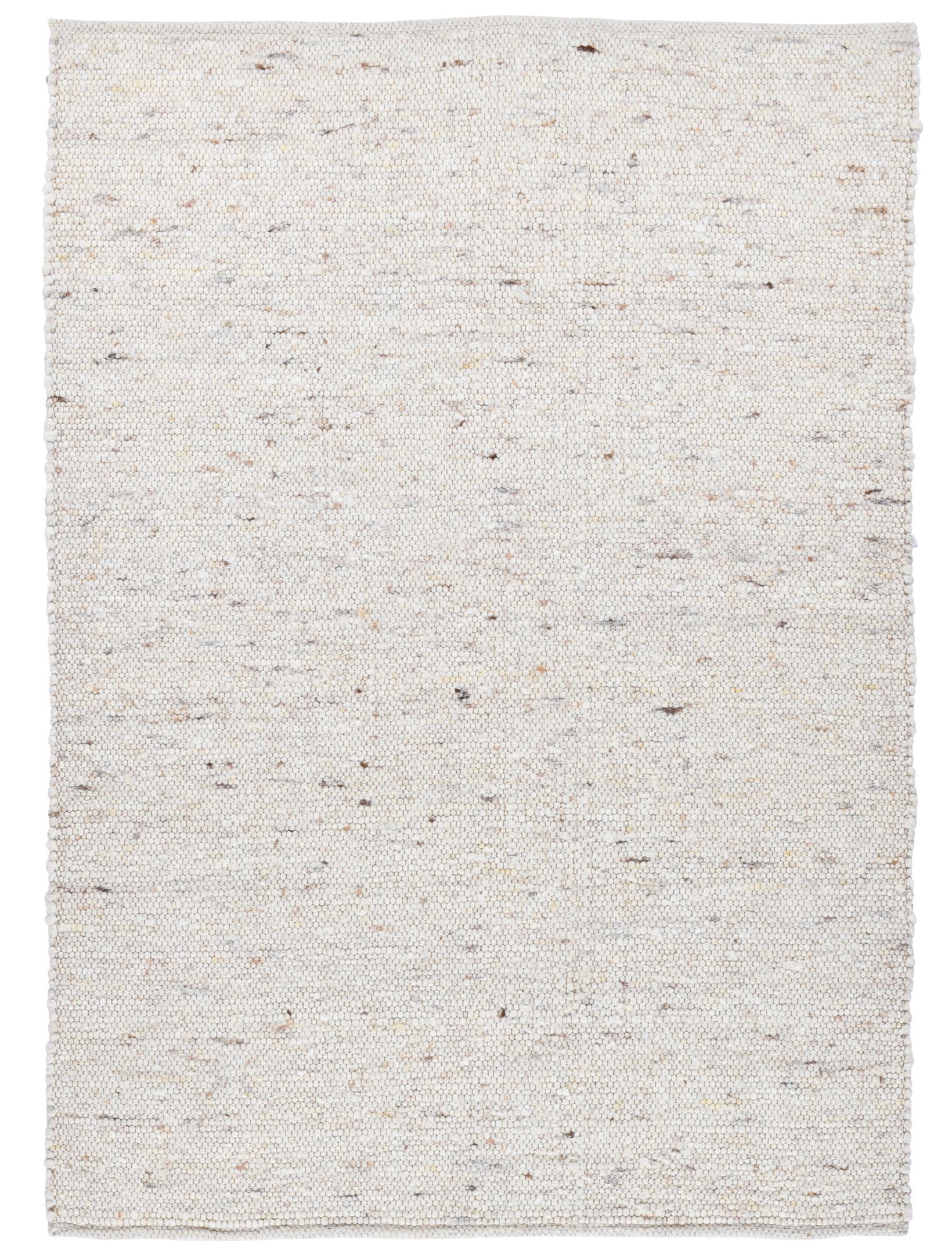

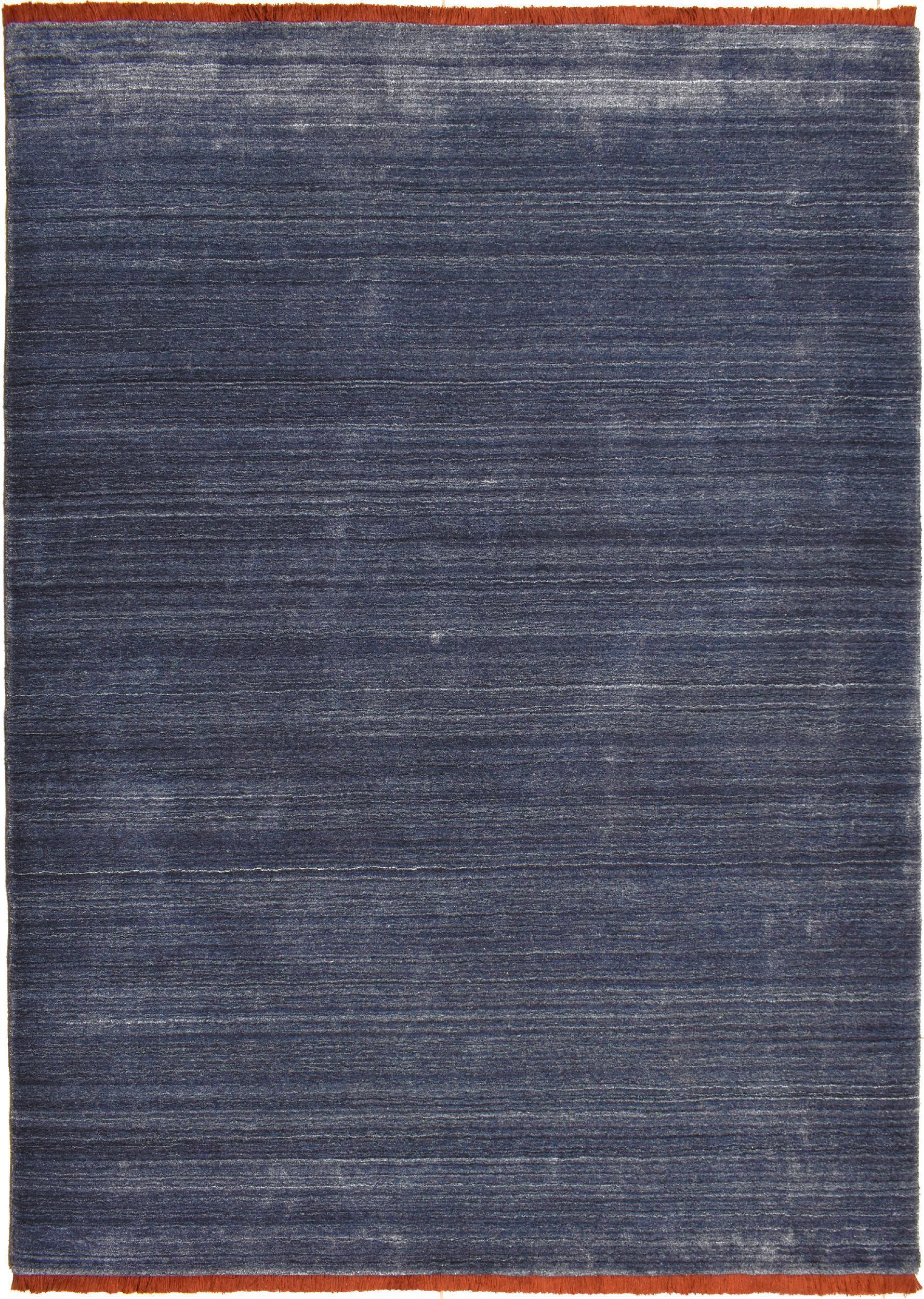


Buying a rug without getting it wrong: start with the right size
The most common mistake when buying a rug is choosing a format that is too small. A rug that is too small makes a furniture group look restless, like a random accessory that has nothing to do with the rest of the room. That is why size comes first, before you decide on colour, pattern or material. If you want to buy a rug that immediately brings the room together, measure first and then choose.
The most important rule of thumb for the living room: at least the front legs of the sofa and armchairs should rest on the rug. This creates a visual connection between the furniture, and the seating area reads as a single unit. The coffee table stands fully on the rug in every arrangement. Depending on the room size, leave around 20 to 50 cm of space to the wall, so that the floor breathes all around and the rug does not look like an overly tight cutout.
One point many people underestimate: in a room, every rug looks smaller than it does on the floor of a shop. The large surface area, the bare walls and the furniture surrounding it all make it appear to shrink. When in doubt, choose the larger option. Common standard sizes available include 140x200 cm, 160x230 cm, 200x300 cm and 250x300 cm. For a large sofa landscape where all the furniture is intended to sit on the rug, you will often need a format from around 300x400 cm. This living island solution ensures that the entire living area reads as a coherent zone.
Before you order, tape the planned dimensions onto the floor with masking tape. This test shows you risk-free whether the size works, how much walking space remains and whether the furniture sits correctly. Five minutes of effort that saves you the biggest frustration. Anyone who follows this approach almost always makes the right choice when buying a rug.
Buying rugs for every room: different requirements at a glance
Every room has its own rules. A rug for the living room is aligned to the seating group, a hallway runner to the traffic route and slip resistance, dining room rugs to chair movement. Thinking this through before buying saves you returns and avoids frustration later with a format that gets in the way in everyday life.
Rug for the living room
The living room is the room where a rug makes the greatest impact. It brings warmth underfoot, dampens sound and defines the seating zone. Follow the sofa landscape as your guide: for smaller groups, having just the front legs resting on the rug is sufficient; for large sofa landscapes, the living island solution is worthwhile, where all the furniture finds space on the rug. The result instantly feels more homely and calm.
Hallway and entrance
In the hallway, robustness is paramount, as this is where the most traffic occurs. A hallway runner in a narrow entrance area should leave around 10 to 20 cm of space on each side to the wall, so that the proportions are right. Important for safety: rugs in passageways or with rolled-up edges are trip hazards. Secure the runner with a non-slip underlay and it will stay exactly where it should. A dirt-trapping mat at the entrance also keeps dirt outside that would otherwise be carried into the living area.
Dining room
Under the dining table, a rug is often chosen too small. The rule: it should extend approximately 60 to 70 cm beyond the table edge on each side. This ensures that the chairs remain on the rug when pushed back and do not tip over the edge. For round dining tables, round rugs work well, with a diameter that exceeds the table by around 140 cm. A low-pile, smooth option is practical in the dining room because crumbs and small stains are easier to remove.
Bedroom and children's room
In the bedroom, it is all about that first feeling in the morning: warm feet on a soft surface instead of a cold floor. A bedroom rug can extend along the sides and at the foot of the bed, or be laid as a pair of runners on either side. In the children's room, a low-pile rug is the safe choice, as it is easier to clean than a high-pile rug and more resilient in everyday life with building blocks and felt-tip pens. Those who wish can add an outdoor rug for the balcony or terrace, which tolerates moisture and sunshine better.
Wool, synthetic or natural fibre: which material suits your use
The material determines comfort, durability and maintenance effort. There is no single best material for everyone, only the right one for your use. Here are the three main groups in direct comparison.
Wool rugs
Wool is the classic choice with the most advantages. The natural wool fat (lanolin) makes the fibres resistant to dirt and water, so that dirt does not work its way in as deeply. Wool absorbs moisture from the air and releases it again when needed, which regulates the room climate. It feels warm and soft, acts as insulation and deadens footfall noise, and is naturally difficult to ignite. Virgin wool develops a patina over the years and stays soft for a long time. Particularly high quality is Himalayan virgin wool: the low temperatures and harsh climate result in a high lanolin content, which enhances dirt and water resistance. The longer the fibre length, the higher the quality of the yarn. Note: wool rugs are not suitable for permanently damp rooms such as the bathroom, and in rarely used rooms they should be protected from moth damage.
Natural fibres: cotton and sisal
Cotton also absorbs moisture, has a thermoregulating effect and is lighter than wool. It is hardwearing and suitable both for warmer months and year-round. Sisal has a rough, firm structure and feels scratchy against the skin, but it is considered difficult to ignite and moth-resistant, which is why it is even used in heavily trafficked retail spaces. Natural fibre rugs are biodegradable and help to balance excess room humidity. A note on care: with natural fibres, many common stain-removal tips found online do more harm than good, as they can damage fibres or colours.
Synthetics: polypropylene, polyester and polyacrylic
Synthetic fibres score highly on care and price. Polypropylene (olefin) is stain-resistant and feels similar to wool in texture, which is why it is often used as a wool substitute. It can usually be cleaned with a vacuum cleaner, but tends to collect dirt at the surface. Pay attention to quality: high-quality fibres are pre-treated and more durable, while cheaper versions often last only a few years under heavy use. Polyester is tear-resistant, hardwearing, colourfast and lightfast, and absorbs little moisture. Polyacrylic feels soft and wool-like, is lightfast and water-resistant. Overall, synthetic rugs are generally easier to clean than natural fibre rugs.
In brief: if you want the best room climate, natural warmth and longevity, wool rugs are the choice. If maximum ease of care at a smaller budget is the priority, good synthetic is the right option. And those who value ecological fibres will find cotton and sisal to be solid everyday companions.
Calm and a good room climate: acoustics, fine dust and living comfort
A rug changes a room noticeably. Hard floors such as tiles or parquet reflect sound strongly, while textile floors absorb it. Rugs convert sound energy into small amounts of heat, thereby reducing the noise level, particularly in the high frequency range between 2,000 and 4,000 Hz. In the low and mid range, the effect is smaller. For real quiet, opt for high-pile: high-pile rugs deliver significantly better sound absorption values than low-pile options. Thicker and denser rugs additionally reduce sound transmission between rooms, that is, impact sound.
A rug also benefits the room air. A rug reduces the fine dust content in the room air by up to 50 per cent compared to smooth floors. In homes with rugs, the average fine dust concentration is around 30 µg/m³, whereas in homes without rugs it is around 63 µg/m³. The reason: on smooth floors, settled dust is easily stirred up with every step, whereas a rug binds it until you vacuum it away. The result is a room that immediately feels warmer, quieter and more comfortable.
Rugs for families, pets and allergy sufferers
Depending on the household, priorities shift. Families with children need comfort and easy cleaning, so a low-pile rug is preferable, as it releases crumbs and stains more readily. A soft rug also gives children a warm, cushioned surface when playing on the floor.
In pet households, robustness and lint behaviour are key. Claws and fur take their toll on a rug, so a low-lint, densely woven rug is the better choice. Viscose should be approached with caution here, as the material is sensitive to moisture and the quality suffers as a result. For pets and damp fur, a robust, moisture-resistant material is more practical.
For allergy sufferers, the good news is: a rug can help reduce the fine dust load in the room air by binding dust rather than stirring it up. House dust mites need warmth and moisture to multiply, which are barely present on the rug itself, so mites reproduce poorly there. An allergy-sufferer household therefore benefits from reduced fine dust compared to a smooth floor. Regular vacuuming remains important, so that the bound dust is removed from the room.
Easy care: treating stains and vacuuming correctly
Concern about maintenance is often greater when buying a rug than the actual effort involved. With a few basic rules, your rug will stay beautiful for a long time.
With fresh stains, the rule is: blot immediately with a clean cloth, without rubbing. Rubbing works the stain deeper into the fibres. Around 90 per cent of all stains are water-soluble and can initially be tested with warm water and a clean cloth. Red wine is an exception: treat it fresh with sparkling mineral water, whose carbonation lifts the stain. Warm water or soap are wrong for red wine, as they can fix the tannins and make the stain worse.
When vacuuming, avoid rotating brushes, as they can damage the fibres. After a large-scale wet clean, leave the rug to dry for at least 24 hours, do not walk on it during this time and ventilate well. Direct sunlight causes colours to fade over time; a little shade preserves the colour depth for longer. A slight new smell from a freshly unwrapped rug is normal; it arises from rolling and packaging and disperses with airing. And a note for natural fibres: many stain-removal tips found online are intended for synthetic rugs only and can damage fibres and colours in wool or sisal.
Buying rugs online safely: free delivery, 30-day returns and a German return address
Anyone wanting to buy rugs online has one main question: what if it looks different at home? That is exactly what our process is designed for. You receive free delivery, have 30 days' right of return and, if needed, a German return address, with no hidden costs. This allows you to look at the rug at home at your leisure, in real light and next to your furniture.
Behind Homerugs stands a family business, the Khodrahm family, which has operated the renowned luxury rug house Negra Carpet & Home with a flagship store in Zurich for decades. We bring this expertise to the internet: high-quality, modern and Scandinavian rug design at fair prices. The focus is on natural materials such as Himalayan virgin wool and gentle dyeing processes, as well as hand-woven and hand-knotted collections and vintage one-of-a-kind pieces rather than cheap mass-produced goods.
Fair production is important to us. Our rugs are certified by the STEP and Care & Fair labels. STEP was founded in 1995 by Swiss aid organisations and monitors licensed dealers through local, independent and unannounced inspections in the most important rug-producing countries, with a standard of up to 90 criteria. Care & Fair was founded in 1994 as an industry initiative against child labour and supports education and health projects in India, Nepal and Pakistan. For you, this means: fair wages and the exclusion of child labour are documented.
How do you recognise high processing quality? By the density of the knotting or weave, a clean and dimensionally stable edge, an even pile and a pleasant feel underfoot. High-quality materials retain their colour and do not thin out as quickly. Precisely this quality makes buying a rug an investment that pays off over many years. Measure your room, do the masking-tape test, choose your material according to use, and order with the reassurance that you can return it within 30 days if it does not work out.
