


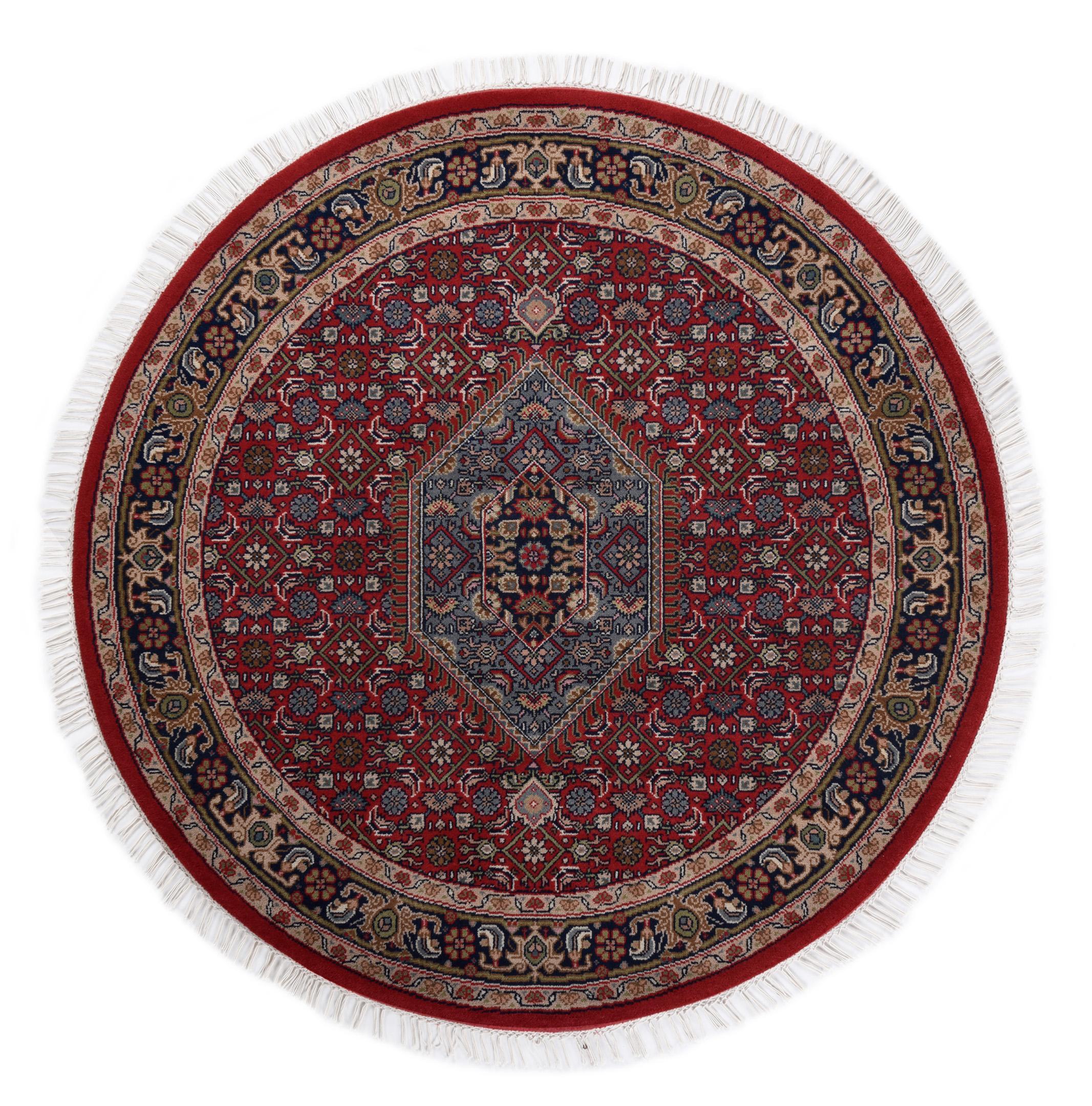
Round rug 100 cm: small in size, clear accent in the room
The most common question about this size: does a rug with only 100 cm diameter actually make an impact, or does it get lost in the room? The answer depends on where you place it. Ø 100 cm is the smallest standard diameter for round rugs and exactly right for a clearly defined zone. As a main rug for a large living room it is too small, but as an accent in the entrance, a reading corner or beside the bed it sits perfectly.
A small round rug defines an area, brings softness underfoot and dampens a degree of sound. The round shape has no hard edges like a rectangular model. This creates a softer transition to walls and furniture, and the room feels more open. A round rug 100x100 cm is therefore the right size for small zones where an accent effect is needed.
Choosing a round rug 100 cm by room: hallway, bedroom, side table
The easiest approach is to choose according to the zone you want the rug to emphasise. A different logic applies to each area.
Hallway and entrance area
In the hallway, a round rug breaks up the angular lines and creates a welcoming starting point just behind the door. Ø 100 cm is sufficient for a narrow entrance hall or as a landing spot in front of the coat rack. Pay attention to a robust material here, as this area takes a great deal of wear.
Beside the bed and in the bedroom
Beside the bed, the rug sits exactly where you first step in the morning: warm and soft instead of a cold floor. Placed as an accent at the foot of the bed, it can be small. If you place it in front of the bed, the centre of the bed should roughly align with the centre of the rug. For a large bedroom as a full-coverage main rug, Ø 100 cm is too small.
Under a side table and in the reading corner
Under a small coffee or side table, a 100 cm rug works well. Imagine a side table next to the sofa: the round rug becomes a base beneath the table and floor lamp, pulling the small corner together. In the reading corner it turns the armchair into its own zone. It also works as a play corner in a children's room, as a soft, clearly defined area on the floor.
Material for the small round rug: what suits which zone
The material determines the feel, care requirements and durability. For a small round rug it is worth choosing by zone.
- Wool: very soft and warm, long-lasting, regulates moisture and, thanks to the lanolin it contains, is less prone to staining. Anti-static, so it attracts less dust. Ideal for the bedroom and reading corner. For entrances with direct access to the outside, wool is unsuitable as it is sensitive to moisture.
- Cotton: soft, lightweight and kind to the skin, straightforward to handle in everyday use. With very intensive use it wears faster than wool. Good for zones with moderate use.
- Polypropylene and synthetic fibres: easy to care for and simple to clean, robust under heavy traffic. Not as soft as wool, but the practical choice for a well-used entrance area.
- Natural fibres such as jute or sisal: bring a natural character, but are sensitive to moisture and therefore better suited to dry living areas.
In short: wool for the bedroom, a synthetic fibre for the heavily used entrance, and for everything else follow your instinct and consider how much care you want to put in.
Choosing colour and pattern correctly for a small area
At 100 cm diameter, every decision counts because the surface area is limited. That is precisely something you can use to your advantage: a small round rug can take a strong colour without overloading the room. A blue rug in a light entrance hall sets a calm colour point against white walls. A red rug under a small coffee table brings a bold accent to an otherwise neutral area where no large living-room rug sits.
For a restrained look, choose a beige rug that blends harmoniously with light floors and lets the shape do the work rather than the colour. With patterns, the rule is: a clear, calm pattern or a plain surface reads more strongly on a small area than a busy mix. The smaller the rug, the clearer the motif.
Round rug 100 cm in everyday life: vacuuming, stains, refreshing
A small round rug is straightforward in everyday use. This routine is sufficient:
- Vacuuming: once a week in normally used rooms. With pets or allergy sufferers, vacuum the heavily used spots two to three times a week.
- Stains: treat immediately. With wool, blot with a clean cloth and absorb the liquid rather than rubbing, as rubbing pushes the liquid deeper into the pile. With cotton, treat with cold water and a mild cleaning agent, also without rubbing.
- Refreshing: you can take a small wool rug outside and shake it vigorously. For heavy soiling or in heavily trafficked areas, a thorough clean every three to six months is recommended, by a professional if in doubt.
Two further points: avoid direct sunlight, as UV rays attack the colours, affecting wool and silk faster than synthetic fibres. And many models are not machine washable, particularly wool and natural fibres. Always check the care instructions before attempting to wash. It is normal for a new rug to shed slightly at first; this decreases noticeably with vacuuming and use.
Common mistakes when buying a small round rug
Most disappointments with Ø 100 cm can be avoided:
- Wrong zone: placing Ø 100 cm as a main rug under a large seating group or a large dining table will disappoint. The rug gets lost there. For a very small table or to accentuate a seating group it is a good fit.
- Slipping on smooth floors: round rugs slide quickly on smooth floors, and waves and rolled-up edges become a trip hazard. An anti-slip underlay increases safety, protects the floor and keeps the rug flat. For underfloor heating, check the product description for suitability.
- Too many small rugs: several small models with different patterns and colours quickly feel cramped and cluttered. Often a single round rug carries a zone better than three small ones.
- Buying a size without checking: mark the desired diameter on the floor with masking tape before buying. That way you can see immediately whether 100 cm looks well-proportioned or whether a size up would sit better.
Comparing sizes: 100 cm and the alternatives
For round rugs, the diameter is given rather than length and width. Ø 100 cm is the smallest standard size; the other common sizes are 120, 160, 180, 200 and 250 cm. For hallways and small corners, Ø 100 cm to Ø 160 cm is the typical range.
A rule of thumb when undecided between two sizes: the slightly larger model looks calmer and more refined in most cases, while one that is too small visually disappears. If you want to frame a seating group or a proper dining table, a round rug Ø 200 cm is the better choice. If you are looking for a clear accent in a small zone, the round rug 100x100 cm is exactly right.
