Urine Smell & Mustiness: Removing Bad Odours from Rugs
Prevention and Quick Action: The Foundation of Successful Odour Removal
Anyone who keeps pets knows the scenario: a wet patch on the living room rug, and suddenly the smell lingers stubbornly in the room. Good news: with the right approach, pet odours can be reliably eliminated, provided you act early enough and choose the appropriate method for the material in question. This guide gives a realistic assessment of home remedies, explains why enzyme cleaners are so effective, and shows when DIY efforts reach their limits.
Two basic rules apply to all rugs: tackle fresh stains immediately and never rub. Anyone who heeds these two points has the decisive advantage on their side.
Material Check First: Not Every Method Suits Every Rug
Before cleaning begins, it is worth taking a look at the material. What works without any problems on a robust short-pile rug made of polypropylene can cause permanent damage to a wool rug.
- Synthetic fibres (polyester, polypropylene, nylon): Tolerate moisture and mild cleaners well. Enzyme cleaners and careful wet cleaning are generally possible.
- Wool rug: Sensitive to acids, aggressive cleaners and excessive moisture. Avoid vinegar solution, bleach and hydrogen peroxide. Enzyme cleaners with a neutral pH, used sparingly, may work. If in doubt, commission professional cleaning.
- Viscose and bamboo: Very sensitive to moisture. Wet treatment can permanently deform fibres or cause them to felt. Professional cleaning is almost always the right decision here.
- High-pile: The long fibres retain moisture and residues deep inside. Thorough drying is particularly important to prevent mould and subsequent odours.
- Hand-knotted and antique rugs: Natural dyes and fragile structures can be irreparably damaged by home remedies. No DIY treatment with liquids without prior expert advice.
Immediate Measures for Fresh Pet Urine
Speed is the most important factor. The shorter the exposure time, the less deeply urine penetrates into the fibres, pile and rug backing.
- Blot, do not rub. Press kitchen paper or an absorbent cloth onto the area from the outside inwards. Rubbing spreads the liquid and pushes it deeper into the rug structure.
- Apply several layers and weigh down lightly. This absorbs as much liquid as possible before it soaks in.
- Use cold or lukewarm water. Hot water and steam cleaners can fix organic residues in the fibres and permanently set the odour.
- Leave out scent sprays and perfumes. They mask the odour temporarily, but do not eliminate the cause.
Step-by-Step Guide for Robust Rugs
- Step 1: Blot fresh urine as described above and absorb as much liquid as possible.
- Step 2: Lightly dampen the affected area with cold water and blot again to dilute the remaining urine.
- Step 3: Apply an enzyme cleaner generously. The product must penetrate as deeply as the urine has soaked in. Leave to act for 10 to 30 minutes depending on the product, longer for old stains.
- Step 4: Allow the area to dry completely in the air. No hair dryer, no radiator directly underneath.
- Step 5: Vacuum thoroughly after drying. If any odour remains, repeat the process.
Important: The area must dry out completely, including beneath the pile. A damp base will smell again after a few hours, even if the surface appears dry.
A Realistic Assessment of Home Remedies: Bicarbonate of Soda and Vinegar Solution
Bicarbonate of Soda
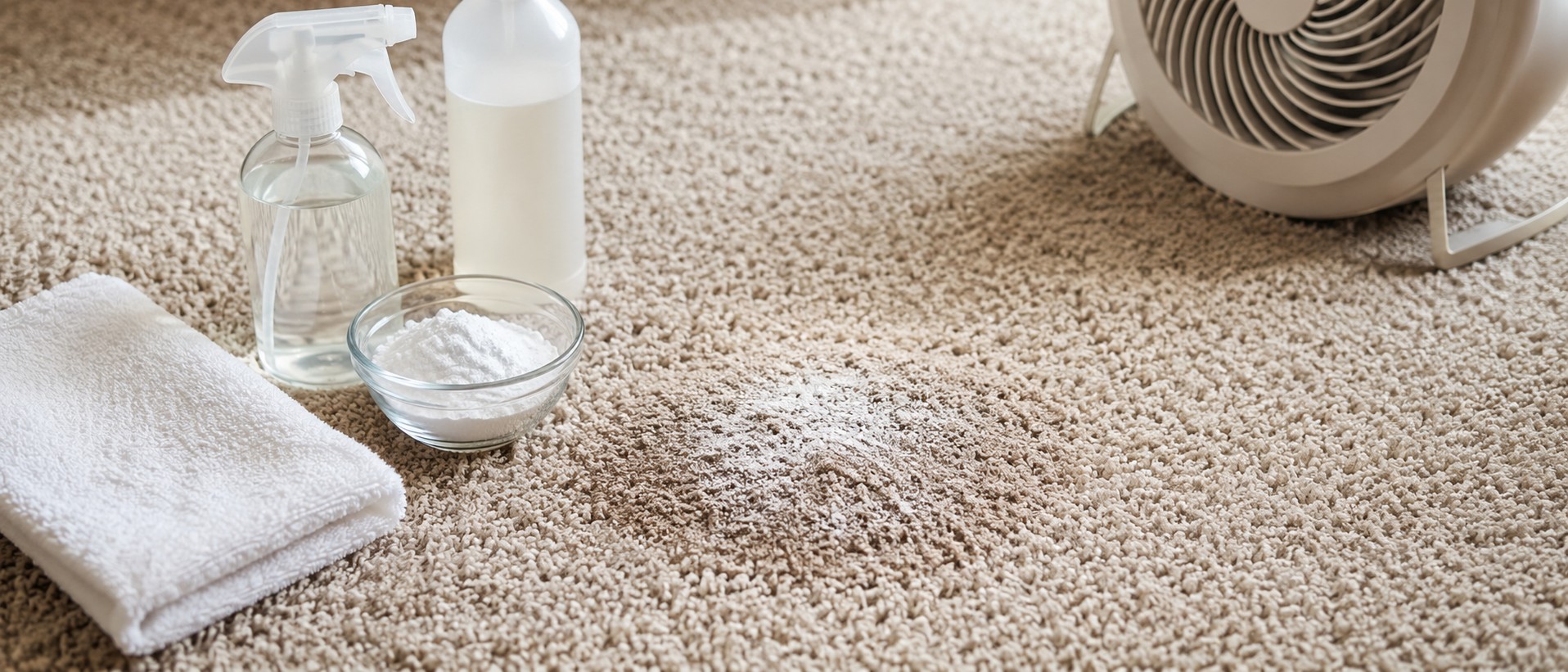
Bicarbonate of soda binds moisture and odour molecules, and is suitable as a supplementary measure for fresh, superficial contamination. Sprinkle generously over the blotted area, leave to act for several hours or overnight, then vacuum thoroughly. Test on an inconspicuous area first, particularly with coloured rugs. For deeply soaked or already dried cat urine, bicarbonate of soda alone is insufficient; an enzymatic product is then required.
Vinegar Solution
A diluted solution of one part white vinegar and two parts water can temporarily reduce fresh odours. For synthetic rugs it is acceptable as a supplementary measure. However, two limitations apply: firstly, vinegar and acid can permanently damage sensitive natural fibres such as wool. Secondly, pet owners report that the intense smell of vinegar can encourage cats and dogs to mark the spot again. For cat urine, an enzyme cleaner is therefore the more reliable choice.
Enzyme Cleaners: How They Work and Why Patience Is Key
Enzyme cleaners contain biologically active enzymes that break down organic molecules in urine at a molecular level. Unlike fragrances or simple household cleaners, they eliminate the source of the odour directly. This is particularly relevant for cat urine, as it is highly concentrated and penetrates especially deeply into fibres.
For an enzyme cleaner to develop its full effect, it requires sufficient time and moisture. The product must not be wiped away too soon. Old or large stains often require two to three treatment cycles. Patience is part of the method here.
Recurring Odour: Why It Returns and What to Do
If the odour returns after cleaning, it is almost always because urine has penetrated deeper into the rug structure than the surface treatment reached. The rug backing, underlay or even the floor beneath can be affected. In these cases, treating only the pile is no longer sufficient.
Specifically: check a foam underlay or anti-slip mat beneath the rug for urine residues in cases of heavy contamination, and replace if necessary. For very old or extensively soaked urine, a professional rug cleaning company using wet extraction methods can dissolve deep-seated residues more effectively than any home method.
What to Avoid at All Costs
- Rubbing: Spreads the stain and pushes liquid deeper into the rug.
- Hot water, steam cleaners and direct heat sources: Permanently fix odours and proteins in the urine.
- Ammonia cleaners: Ammonia is a natural component of urine and can encourage animals to mark the spot again.
- Bleach: Damages fibres and leaves discolouration.
- Too much water at once: A saturated rug with a damp backing provides ideal conditions for mould growth.
- Odour maskers: Conceal the problem, but do not resolve it.
When Professional Cleaning Is the Better Choice
With all rugs there are situations where DIY efforts reach their limits. Professional cleaning is recommended when the rug is made of wool, silk or viscose, when it is a hand-knotted or antique piece, when the stain is large or the urine has soaked deeply into the backing and underlay, when the odour returns despite repeated home treatment, or when discolouration has occurred or a mouldy smell appears. In some cases, particularly with heavily contaminated rug backings or damaged underlays, replacing the rug may be the more economically and hygienically sensible decision.
Prevention: Reducing Risks from the Outset
Pet owners can significantly reduce the risk of damage with targeted measures. Treating accidents immediately remains the most important rule. In addition, a washable rug underlay is recommended as a first barrier between urine and the floor. Regular airing and vacuuming prevents the gradual musty odour that can become ingrained in all rugs. Anyone furnishing a living room or heavily used areas with a rug will benefit from models designed for straightforward care.
FAQ
How do I remove pet urine odour from my rug?
Blot fresh urine immediately with absorbent kitchen paper, working from the outside inwards, and never rub. Lightly dampen the area with cold water and blot again to dilute residues. Apply an enzyme cleaner generously and leave to act for at least 10 to 30 minutes, longer for old stains. Allow the area to dry completely in the air, then vacuum. Repeat the process if any odour remains, until the smell has completely disappeared.
Is bicarbonate of soda an effective remedy against urine smell in rugs?
Bicarbonate of soda binds moisture and odour molecules, and is suitable as a supplement in fresh, superficial cases. Sprinkle generously over the blotted area and leave to act for several hours or overnight. Then vacuum thoroughly. Test on an inconspicuous area first, particularly with coloured rugs. For deeply soaked or dried cat urine, bicarbonate of soda alone is insufficient: an enzyme cleaner is required in such cases.
Can I use vinegar against cat urine in a rug?
Diluted vinegar solution can temporarily reduce fresh odours on robust synthetic rugs. On sensitive natural fibres such as wool, vinegar can permanently damage fibres and dyes. The intense smell of vinegar can encourage cats and dogs to mark the spot again. For cat urine, an enzyme cleaner is the more reliable and material-friendly choice.
Why does the rug still smell of urine after cleaning?
Urine has penetrated deeper into the pile, rug backing or underlay than the treatment reached. The cleaner's contact time was too short, or the product had no enzymatic action. The area was not dried out completely after cleaning. The underlay or the floor beneath may also be contaminated and should be checked. Solution: treat again with an enzyme cleaner, allow to dry completely, and consider professional wet extraction for deeper contamination.
When is it worth having a rug professionally cleaned?
For wool rugs, silk, viscose or hand-knotted rugs, where aggressive home remedies can damage fibres or dyes. For old, dried or large stains that have penetrated deeply into the rug structure. When the odour returns despite repeated home treatment. When discolouration has occurred or mould is suspected. When the piece is high-value or antique, where any risk is too great.