Arabesque rug: what lies behind the sweeping tendril pattern
The arabesque: from antiquity through Islamic art to Europe
When you read the word "arabesque" on a product page, there is a very long history behind it. The ornament was developed as a decorative element in Hellenistic-Roman art and later adopted by Islamic art. There it became the predominant decorative element across all disciplines. The term itself only emerged in Europe, via the French "arabesque" and the Italian "arabesco", and ultimately derives from the Arabic word for "Arab".
Through Moorish art, the pattern made its way to Spain and from there to Europe. There it was transformed into the clearer, simpler Moresque, which is frequently seen on silverwork in the 16th century. Particularly impressive examples can still be found today in many halls of the Alhambra in Granada. This journey explains why the arabesque is regarded in our part of the world as a classic oriental element: it stands at the heart of a tradition that has travelled across centuries and multiple cultures.
Why the prohibition of images gave rise to an entire visual language
Rich ornamentation is one of the defining characteristics of Islamic art. This is precisely what the European term "arabesque" refers back to. This highly developed culture of ornament is attributed to the Islamic prohibition of images. Artistic imagination concentrated on this means of expression and created a visual language that was comprehensible and aesthetically satisfying to the Muslim viewer.
Islamic ornament can be broadly divided into three areas: the arabesque with its curvilinear plant elements, geometric patterns, and calligraphy. The arabesque is thus a distinct branch of this visual language, namely the florally oriented one. This is the reason why it so frequently appears on rugs alongside other abstracted plant motifs.
The arabesque ornament explained: leaf volute, tendril stem and the partial spiral
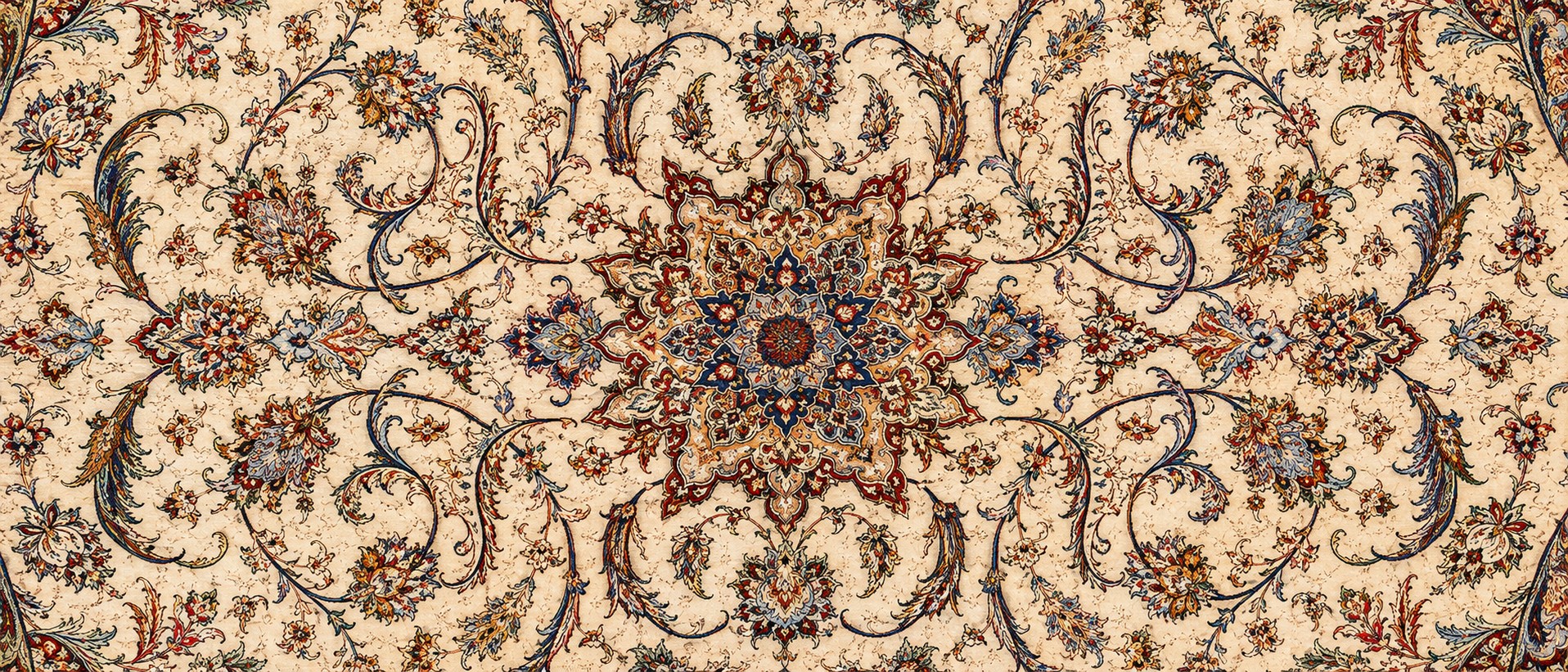
Technically, the arabesque is a stylised leaf and tendril ornament. Rug lexicons describe it as an elaborate, flowing pattern that winds and partly spirals through oriental works of art and rugs. It consists of a foliage tendril made up of two elements: a repeating, split leaf volute and a connecting tendril. This basic form can be extended with blossoms, leaves or clouds.
In Persia, this pattern is known as Eslimi (also Islimi); the Turkish term is Rumi. In Europe, both are familiar as the "arabesque design". On the rug, the ornament serves a subordinate function: it structures, emphasises, fills and frames. The arabesque ornament is particularly pronounced in the medallion-centred Eslimi pattern, where it often terminates in forked tendrils, and as a continuous tendril border on many florally patterned knotted rugs. Incidentally, such a pattern is designed knot by knot on a cartoon, a kind of pattern template.
Geometric or floral: two fundamental styles and where the arabesque stands
Two major pattern styles are distinguished in oriental rugs. The geometric style works with horizontal, vertical and diagonal lines that divide the rug into fields. It predominated from the 11th to the 13th century, particularly in Anatolia under the Seljuks. The floral style stands in contrast to this: curved, softer lines and rounded movements.
The arabesque belongs clearly to the floral style. This is precisely where its appeal lies for many classic rugs and Persian rugs: the pattern flows rather than divides. So if you are considering whether a rug feels more austere or more soft, the arabesque is a reliable indicator of the soft, flowing direction.
Medallion is not arabesque: the most common confusion
Medallion and arabesque are often lumped together, but they are two different things. A medallion is a central figure in the middle of the rug. Complementing it are four corner fields, filled with mirrored quarters of the medallion or with their own ornaments. Together, the medallion and corner fields form a composition that is symmetrical about both axes.
A good contrasting example is the Caucasian medallion: strictly geometric, without any floral elements, and often repeated multiple times in two or three rows rather than appearing as a single central element. The arabesque, by contrast, is the floral tendril work that can play around a medallion, terminate in forked tendrils, or run as a border around the entire pattern. On modern Isfahan rugs, for example, designs made up of lines and arabesques appear, with medallions being the most common motif. The two therefore frequently appear together but do not mean the same thing.
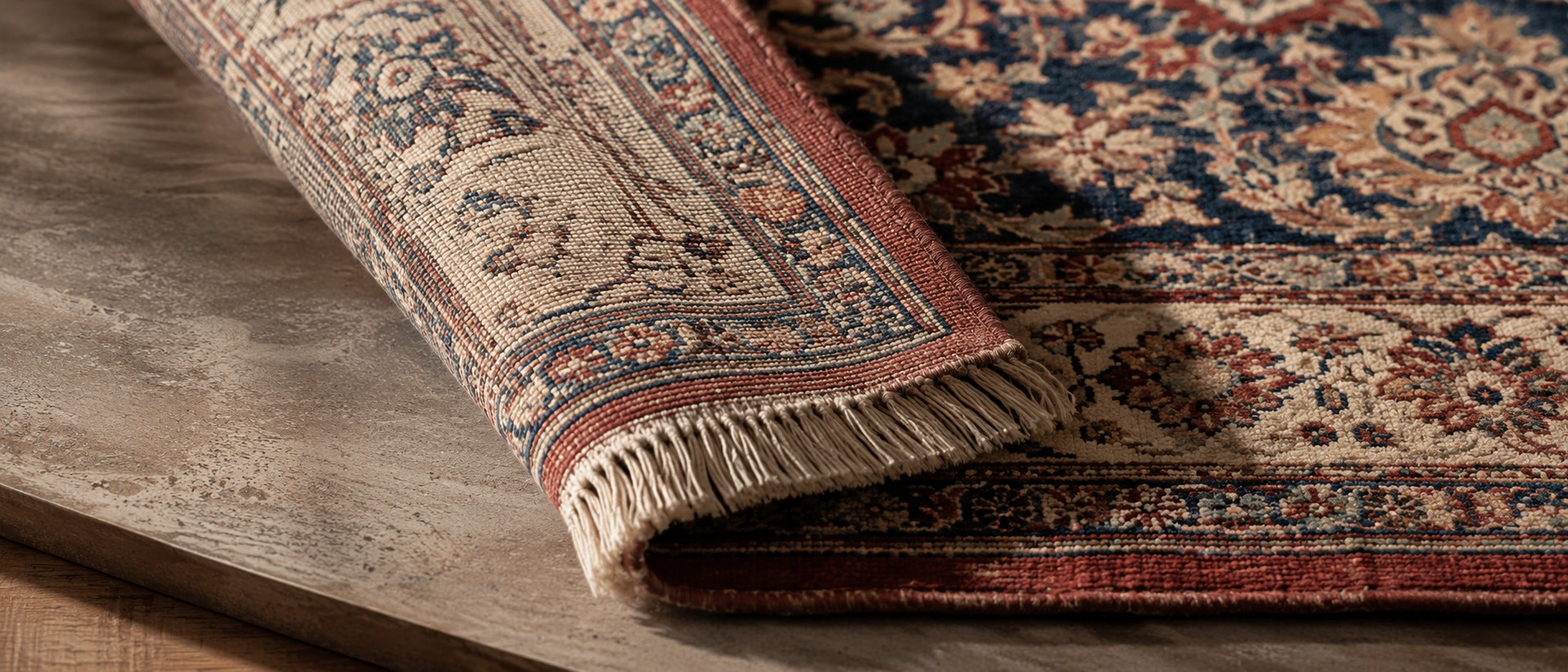
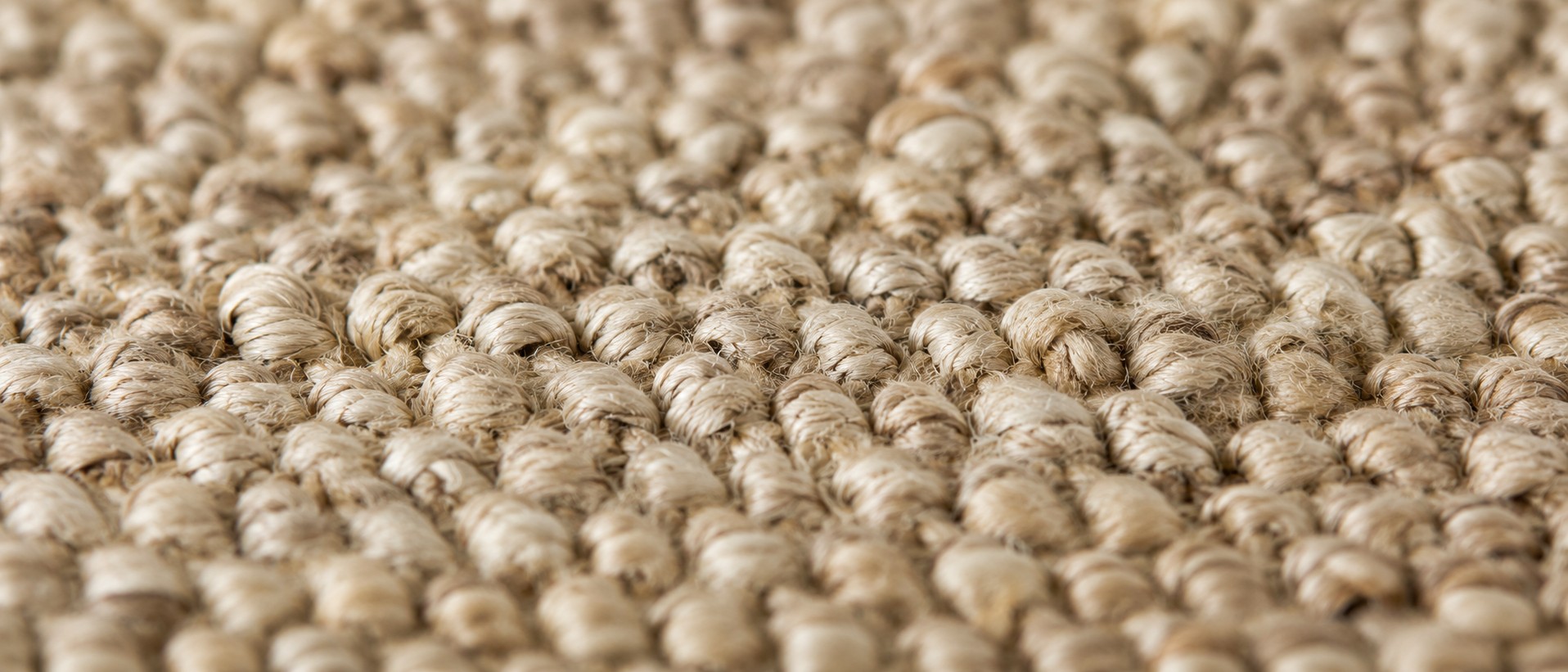
You should also distinguish the arabesque from kilim and Berber rugs. Kilim rugs are hand-woven, have no raised wool pile and tend to carry simple, rectilinear patterns determined by the weaving technique. Berber rugs are hand-knotted oriental rugs, mostly from Morocco, with a pile made of virgin wool and characteristic geometric or minimalist diamond designs. Both therefore work with geometry rather than the flowing tendril.
How a rug with an arabesque ornament works in a living space
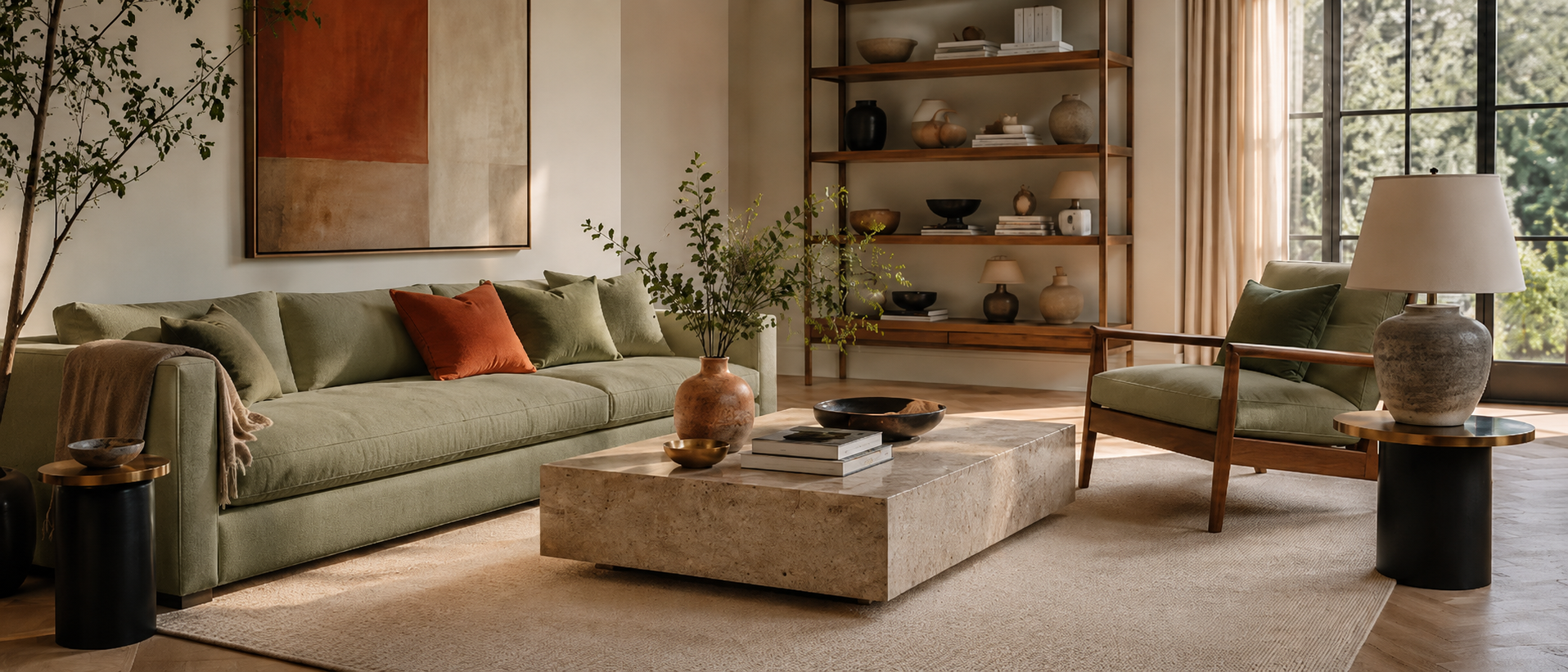
Flowing oriental patterns in muted tones bring an elegant, nostalgic quality to a room. An oriental rug with an arabesque ornament can bring warmth to a living room while becoming its focal point. The beauty of it is that such a Persian rug works in both minimalist and opulent interiors, because the pattern organises the surface and guides the eye.
Stylistically, the ornament is versatile. It suits the oriental and classic look, but also appears in Boho-chic: there, Moroccan Berber patterns and nomadic diamond motifs mingle with elaborate Persian ornaments featuring medallions and refined arabesques. A rug with an arabesque ornament is therefore a good anchor when you want to give modern furniture depth and history.
Buying guide: styles, colours and formats at a glance
When it comes to size, a simple rule of thumb helps: the rug should be large enough for all the furniture in a seating group to fit on it. For a medium-sized living room of 15 to 25 sq m, around 200x300 cm is a good choice. Smaller rooms, larger rooms: the overview below gives you guide values.
| Room size | Recommended format |
|---|---|
| Small living room up to 15 sq m | 140x200 cm to 160x230 cm |
| Medium living room 15 to 25 sq m | 200x300 cm to 250x350 cm |
| Large living room over 25 sq m | from 300x400 cm |
Common standard sizes such as 120x180 cm, 160x230 cm or 200x290 cm are rectangular and easy to plan with. On the subject of colour, a practical point: light, plain-coloured rugs show stains more quickly and can look unsightly if they are not cleaned regularly. Darker, mottled or patterned qualities are more forgiving in everyday use, because the pattern conceals small stains and wear for longer. For hallways and heavily used family rooms, a dark, patterned rug is therefore the lower-maintenance choice. An arabesque ornament with a great deal of movement works in your favour here, because it maintains the visual impression of cleanliness for longer.
FAQ
Where does the arabesque come from culturally and historically?
The arabesque was developed as a decorative element in Hellenistic-Roman art and subsequently adopted by Islamic art. Through Moorish art it made its way to Spain and from there to Europe, where it was transformed into the clearer Moresque. Particularly impressive arabesques can be found in the halls of the Alhambra in Granada. This journey explains why it is regarded today as a classic oriental element.
What does the arabesque ornament mean on a rug?
It is a stylised, flowing leaf and tendril ornament that winds and partly spirals across the rug. It consists of a foliage tendril made up of two elements: a split leaf volute and a connecting tendril. On the rug, the ornament structures, emphasises, fills and frames the pattern, for example as a continuous border or around a medallion.
How does the arabesque differ from a medallion pattern?
A medallion is a central figure in the middle of the rug, complemented by four corner fields to form a symmetrical composition. The arabesque, by contrast, is the floral tendril work that can play around a medallion or run as a border. The two frequently appear together but do not mean the same thing. A Caucasian medallion, for example, is strictly geometric and without any floral elements.
What interior style suits a rug with an arabesque ornament?
It suits oriental and classic looks, but also works in Boho-chic, where Persian ornaments featuring medallions and arabesques meet Berber patterns and diamond motifs. Flowing patterns in muted tones bring an elegant, nostalgic quality to a room. A Persian rug can become the focal point in both minimalist and opulent interiors.
What do Eslimi and Rumi mean?
Eslimi (also Islimi) is the Persian term for the arabesque pattern; Rumi is the Turkish term. In Europe, both are familiar as the arabesque design. Both refer to the same basic form: a foliage tendril of a split leaf volute and a connecting tendril, which can be extended with blossoms, leaves or clouds.