Handknotted or Well Imitated? How to Identify a Genuine Rug
What "genuine" really means for a rug, and what it does not
I have been examining rugs for more than thirty years: at auctions, in warehouses, at flea markets, in private homes. One thing comes up time and again: the word "genuine" carries more meaning than it can bear. In the rug trade it refers almost exclusively to handknotted, meaning a rug whose pile was tied knot by knot by hand. It is not an automatic promise about age, region or price level, only about the method of production.
A handknotted rug can be young, affordable, and still made from modest wool. And a rug with a generous price tag from an upmarket shop can be machine-made. Once you have understood this distinction, you buy with greater confidence and are less dazzled by inflated fantasy prices.
Price, origin and condition: what truly determines value
Many buyers equate "genuine" with "valuable". That is a misconception I see far too often in the trade. Handwork is a characteristic of the production method, not a guarantee of value. A handknotted rug can be heavily worn, made from chemically dyed, inferior wool, or originate from a region for which there is little demand. The actual value only emerges from the interplay of material, condition, origin, pattern and knotting technique.
With heirlooms, auction finds or online purchases: labels and statements of origin are easy to falsify or exaggerate. The physical characteristics of the rug itself are more reliable than any certificate without verifiable proof. For expensive individual pieces, an independent expert is the safest investment.
The quick check on the rug: what eyes and hands reveal
1. Material: what your fingertips can feel
Traditional oriental rugs consist almost entirely of natural materials: sheep's wool, cotton, camel hair or silk. Wool feels slightly warm and minimally greasy. Silk is cool, smooth and throws a characteristic lustre in the light. Synthetic fibres feel more uniform and lifeless. The back provides a particularly clear warning sign: a glued latex layer or an industrial backing indicate machine-made or hand-tufted production.
Hand-tufted means: a craftsperson shoots loops of yarn into a backing fabric using a tufting gun. That is handwork, but not hand-knotting. For longevity and resale value, this distinction is significant.
2. Knot pattern and knot density: how to assess them correctly
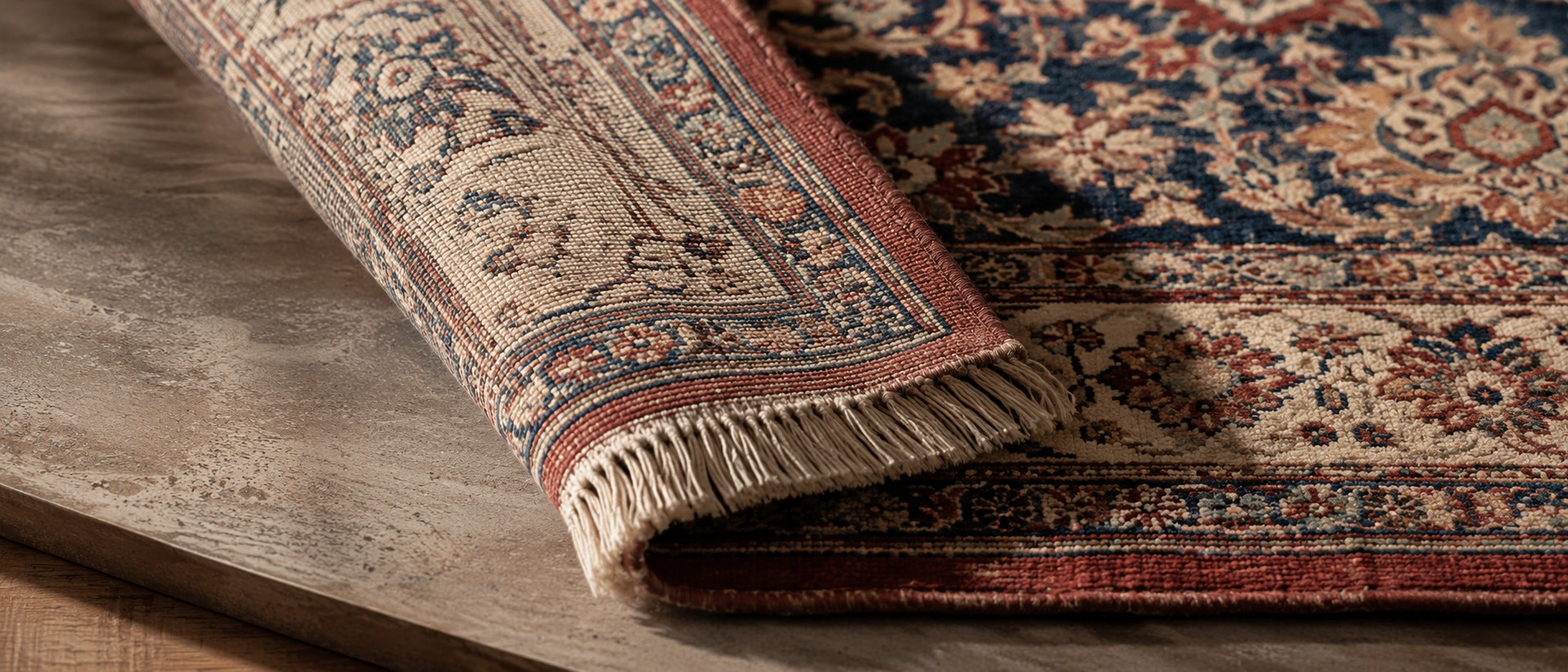
Turn the rug over and look at the back. On a handknotted piece you will see individual, slightly irregular knots in rows that never look machine-perfect. Small offsets, minimal spacing differences between knots: these are signs that a human being worked here. Machine-made goods show an exactly uniform, woven pattern without any deviation.
Knot density, meaning the number of knots per square centimetre, says something about the fineness of the pattern and the level of craftsmanship involved. Fine pieces from Qom or Nain can reach several hundred knots per square centimetre; coarse tribal rugs perhaps twenty. But a quality judgement cannot be derived from knot density alone. A rug with a high knot count in inferior wool can be worth less than a coarsely knotted rug in high-quality new wool with plant dyes.
3. Fringes: grown from the weave or added on?
Fringes on a genuine handknotted rug are not a decorative element. They exist because the warp threads of the foundation weave extend beyond the knotted field and are bound off at the end. The fringe is therefore an organic part of the rug. Pull gently on a fringe: if you feel a direct connection deep into the weave, that is a good sign. Fringes that look neatly sewn or glued on and feel like an addition are a clear signal of machine production. Look particularly closely at the transition between the fringe edge and the back.
4. Pattern and symmetry: imperfection as a mark of authenticity
Complete symmetry sounds like a masterpiece of craftsmanship, but it is the exception in handknotted rugs. Even experienced knotters work from a cartoon or from memory, and minimal irregularities in the ornament, line work or medallion arise quite naturally. These subtle deviations are an indicator of handwork. Machine-made goods, by contrast, repeat their pattern with pixel-perfect precision and without any variation.
5. Abrash: colour variation as the fingerprint of handwork
Look at an apparently uniform colour field in daylight, for example the blue in the central field. Can you see slight differences in brightness or tone within the same colour? This phenomenon is called abrash and occurs when the knotter has used different batches of yarn or dye baths. In handknotted rugs with natural plant dyes this is almost unavoidable and is regarded by experts as an indicator of genuine handwork. Abrash in itself is not a defect. Caution is warranted with abrupt, very strong colour changes: these can point to later repairs or uneven fading. When in doubt, the back will show whether any area has been worked on.
Genuine Persian rug: what the term delivers and where it ends
In the strict sense, "Persian rug" denotes a handknotted rug from Iran, from one of the classical knotting regions such as Tabriz, Nain, Bijar, Kerman, Kashan or Isfahan. The term says something about geographic origin. It says nothing, initially, about quality, condition or value. Not every oriental rug is a Persian rug: oriental rugs come from a considerably larger geographic area, including Afghanistan, Turkey, Pakistan and India. Anyone buying or inheriting a Persian rug should examine the physical characteristics of the piece itself, rather than trusting the label.
Which photographs you need for an initial assessment
Anyone buying a rug online or wishing to have an inherited piece valued should provide at least these images:
- Full-surface back: shows the knot pattern and foundation construction
- Fringe edge close-up: reveals whether the fringes grow organically from the weave
- Macro shot of the surface: for pile height, fibre texture and lustre behaviour
- Colour fields in bright daylight: makes abrash visible
- Any existing labels or certificates
With these images an experienced dealer or appraiser can provide a well-founded initial assessment from a distance. For valuations that are legally or insurance-relevant, an in-person inspection is always required.
Quick comparison: handknotted vs. machine-made
- Back: Handknotted shows visible, slightly irregular knots. Machine-made has a uniformly woven pattern.
- Fringes: Handknotted fringes grow from the warp threads. Machine-made rugs often have sewn-on or glued fringes.
- Pattern: Handknotted displays minimal deviations. Machine-made is pixel-perfect in its symmetry.
- Material: Handknotted mostly natural materials. Machine-made frequently synthetic or latex-backed.
- Abrash: Handknotted with natural dyes often shows subtle colour nuances. Machine-made is uniformly dyed.
- Value: Handknotted varies greatly by material, origin and condition. Machine-made is generally less costly to produce.
FAQ
How do I check whether a rug is truly handknotted?
Turn the rug over: handknotted rugs show individual, visible knots with slight irregularities in spacing. Machine symmetry is absent: perfectly uniform rows indicate industrial production. Check the fringes: with handwork they form a natural extension of the warp threads from the foundation weave. Examine the pattern: minimal deviations in the ornament or line work point to a human knotter.
What do the fringes reveal about the method of production?
Genuine fringes are an organic part of the rug: they exist because the warp threads extend beyond the knotted field. Sewn-on or glued fringes are a strong signal of machine-made goods on classical oriental and Persian rugs. Look closely at the transition between the fringe edge and the back: that is where you can see whether the fringes have grown from the weave or been added on.
Does a high knot density automatically make a rug better?
Knot density allows for finer patterns and reflects the level of craftsmanship, but it is only one factor among several. Material, wool quality, dyeing (plant dyes vs. chemical), origin and condition count equally. A coarse tribal rug in high-quality new wool with natural dyes can be clearly superior to a fine piece in inferior wool. Anyone who looks exclusively at the knot count does not get a complete picture of the value.
How do I tell whether a Persian rug truly originates from Iran?
A genuine Persian rug is handknotted and comes from Iran, from traditional knotting regions such as Nain, Tabriz, Bijar, Kerman or Kashan. Natural materials such as sheep's wool, cotton or silk are typical; the back shows the characteristic knot pattern. Importantly, not every oriental rug is a Persian rug. Oriental rugs come from a far larger area, including Afghanistan, Turkey or Pakistan. Labels alone are not sufficient evidence; the physical characteristics of the piece itself are decisive.
What is behind abrash, and should it be considered when buying?
Abrash refers to slight colour variations within an apparently uniform colour field, for example lighter or darker zones in the red of a central field. The cause is different batches of yarn or dye baths, which is almost unavoidable in handknotted rugs with plant dyes. In the trade, abrash is regarded as an indicator of genuine handwork and natural dyeing, not a defect. However, abrupt, very strong colour changes can point to repairs or uneven fading; in that case a close look at the back is worthwhile.