Abrash Meaning: what the colour stripes in a rug really reveal
Abrash meaning: piebald, speckled, a word on its travels
The abrash meaning is hidden in the word itself, and that word has travelled quite far. In Turkish, abraş means something like piebald or speckled, and the Turkish word is in turn borrowed from Arabic, where abrash means spotted or speckled. Other traces lead to Persian: some derive the term from the word for dyeing, others even from the word for cloud. The origin is not entirely clear-cut.
In English you often encounter both spellings, abrasch and abrash. German lexicon entries and many dealer glossaries use abrasch, while international sources tend to prefer abrash. Both refer to the same thing: a visible change in colour tone in the pile. In German this is also called Farbsprung. Merriam-Webster dates the first recorded English use of the word to 1911, though the phenomenon itself is of course far older.
And that is precisely what is appealing: anyone who looks at the etymology immediately understands that speckled colour belongs to the hand-knotted rug. It is a characteristic for which a dedicated technical term has existed for over a hundred years.
From the dye bath to the stripe: how abrash arises technically
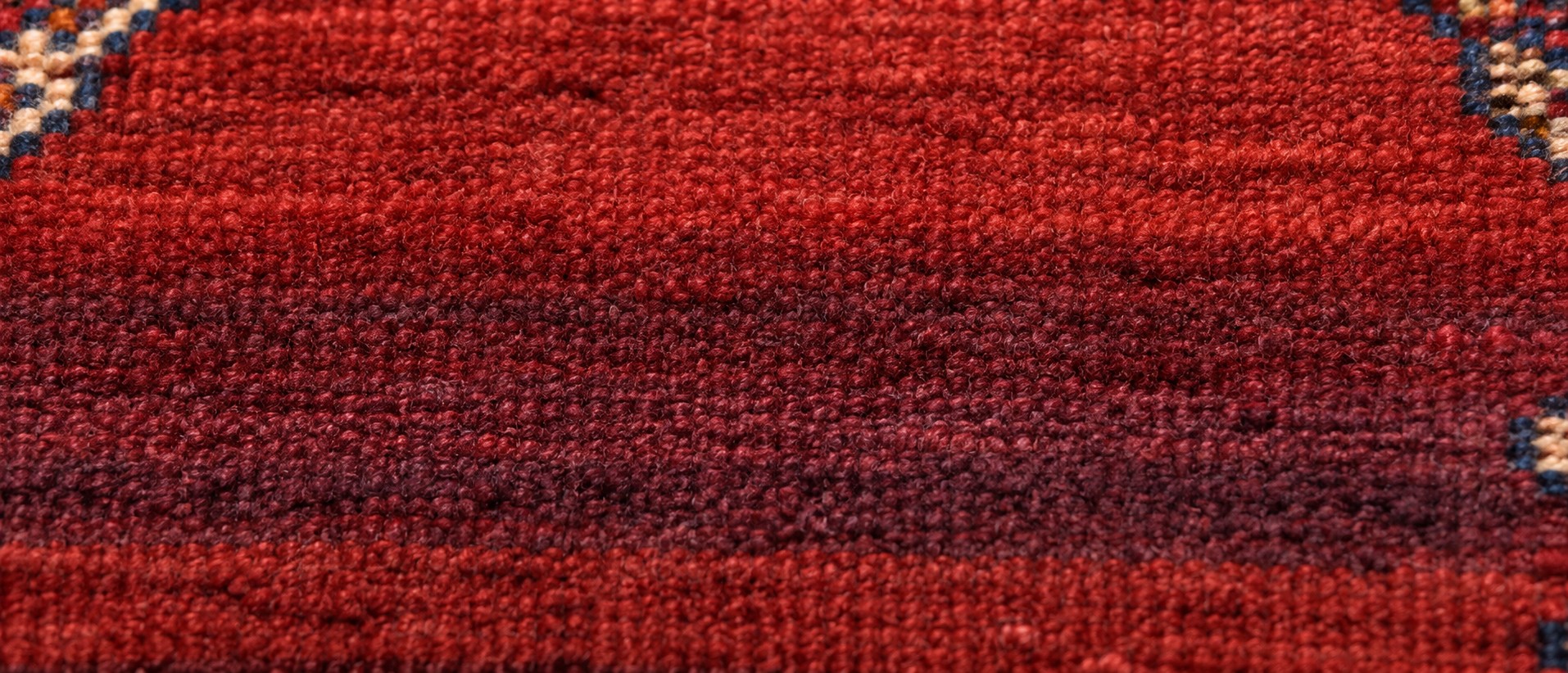
Technically speaking, abrash is a slight to pronounced change in colour tone in the pile yarn, and it always runs transversely to the lengthwise direction of the rug. The reason lies in the work at the loom. One batch of yarn runs out, the next knot comes from a new skein or roll, and this new yarn was dyed in its own separate batch. Even with careful dyeing, two batches never turn out exactly the same.
Many small factors interact during the dyeing process. The temperature of the dye bath fluctuates. The consistency of the dye is sometimes slightly denser, sometimes thinner. Cooking times vary in length. Add to this sun drying, different mordants, the residual fat content of the wool, and the mineral content and pH value of the water used. Any one of these factors can shift the finished tone slightly.
The result is visible as a horizontal band or as a soft, gradual transition running through the field or the border. Abrash can appear across a broad area, in stripe form, or only at isolated points. Some Persian rugs display it barely at all; others carry it boldly throughout the entire piece.
Why natural dyes stripe and industrial yarn does not
A large part of the answer lies with the dyes. With natural dyeing using madder, indigo, or walnut, the pigments vary in their concentration, and this variation ends up directly in the wool. For this reason abrash is almost always present in naturally dyed yarns.
The wool itself plays a role as well. Natural wool tones range from beige through brown to black, and depending on the base tone, the fibre takes up the dye differently. The same dye bath can produce a slightly different tone on lighter and darker wool. This too generates abrash.
Chemically dyed yarns behave differently. Pigment control in industry is so precise that a uniform surface results. Genuine machine-made goods draw their yarn from large, industrially exact dye batches and carry the colour evenly. In such pieces abrash rarely occurs, at most in very large formats or when multiple looms are involved.
Three reasons why collectors read abrash like a signature
For collectors and dealers, abrash is often a positive signal. Three arguments underlie this view.
- Abrash points to natural dyeing. Anyone using madder, indigo, reseda, or walnut will inevitably encounter batch variation. The presence of abrash is considered primarily as evidence of natural dyes.
- Abrash signals hand-knotting. Rugs in which abrash is visible are regarded as hand-knotted. Industrial tufted or woven rugs show it practically not at all, because they are produced from continuous industrial yarns.
- Abrash gives a rug vitality. The fine stripes and transitions bring depth and a decorative interplay of colour shadows into the field. Plant-based dyes also develop a patina over time that intensifies this effect across the years.
According to consistent expert opinion, abrash rarely diminishes the value of a rug significantly. On the contrary, it can even enhance both aesthetics and authenticity. In a genuine abrash hand-knotted rug, the colour variation is therefore part of the story, not a flaw.
Genuine and fake abrash
Because abrash carries such positive associations, it is occasionally produced artificially. In mechanically manufactured rugs, abrash can be incorporated to deceive the buyer by simulating an authentic appearance. Some manufacturers of high-quality machine-made goods even invest considerable time and expense to simulate abrash. Three pointers help you when examining a piece.
- Direction of the stripes. Genuine abrash runs horizontally, in bands parallel to the rows of knots. If stripes run diagonally or in all directions, that is a cause for suspicion.
- Consistency throughout the piece. Genuine abrash appears in several fields and borders, because yarn batches were changed for different parts of the rug. Artificially faked abrash often sits in only one area.
- Look at the reverse side. Turn the rug over. In hand-knotted goods the pattern is just as clearly recognisable on the back as on the front, and genuine abrash also shows as a dyeing difference. In machine-made goods the reverse looks blurred, with a coarse grid or an applied backing.
An important note on the subject of natural colour: indigo blue and madder red can today be chemically imitated with precision. Whether a colour is truly natural can therefore often only be established with elaborate chemical testing. A reliable laboratory test by laypeople is, realistically speaking, barely possible.
Where abrash is at home: nomadic rugs, Heriz, Kashan
Some knotting traditions display abrash more regularly than others. The most pronounced examples are nomadic and village rugs. Here the wool is usually dyed by hand in small batches, which makes abrash particularly common. In these pieces the colour variations are virtually part of the package and, depending on one's perspective, are tolerated or even desired.
Finer Persian rugs also display the phenomenon. Heriz rugs, for instance, frequently shift colour through a tonal change from one end of the rug to the other. Kashan is likewise cited as an example of the abrash dyeing technique, even in finer pieces. These classic rugs carry the colour shift as part of their character.
In trade catalogues of antique Oriental rugs, abrash examples also appear among styles such as Sirjan, Shiraz, Serapi, and Sarab. These are marketplace examples rather than a systematic study, but they illustrate the range well.
When abrash speaks against the workshop
Abrash is therefore often a good sign, but not invariably so. In very fine workshop rugs the assessment is reversed. Such pieces should be largely free of abrash, and visible abrash here is regarded more as an indication of less careful workmanship.
The reasoning is straightforward: fine workshops operate with large dye houses and long, precisely controlled yarn batches. When dyeing is closely managed, abrash barely arises. Pronounced colour shifts in a piece that is being sold as very fine workshop production should therefore make you attentive.
In brief, the assessment depends on the type. In a nomadic piece or a village rug, abrash is an expression of handcraft and natural dyeing. In the very finest workshop rug, a highly uniform surface is the goal. Anyone who reads the abrash meaning in this context will judge a rug more fairly and arrive at a calmer purchasing decision.
FAQ
What does abrash mean in a rug exactly?
Abrash is a visible change in colour tone in the pile yarn of a hand-knotted rug, which always runs transversely to the lengthwise direction. It arises when the knotting moves from one yarn batch to a new one that was dyed in its own separate batch. Because two batches never turn out exactly the same, a stripe or a soft transition becomes visible. In German this is also called Farbsprung.
Where does the word abrash come from?
The word has travelled far. In Turkish, abraş means piebald or speckled, and this word derives from the Arabic abrash, meaning spotted. Alongside this there are Persian interpretations relating to dyeing or even to cloud. The origin is not entirely clear-cut. Merriam-Webster dates the first recorded English use to 1911.
Why do natural dyes produce more abrash than synthetic dyes?
Because natural pigments from madder, indigo, or walnut vary in their concentration and every dye batch turns out slightly differently. In addition, differing natural wool tones ranging from beige to black take up the dye in different ways. Synthetic dyes can be controlled industrially with such precision that a uniform surface results and abrash barely occurs.
Which types of rug show abrash most frequently?
Nomadic and village rugs, because the wool is dyed by hand in small batches Heriz rugs, often with a tonal shift from one end to the other Kashan as an example of the abrash dyeing technique in finer pieces In antique rug catalogues, also styles such as Sirjan, Shiraz, Serapi, and Sarab
How does abrash arise technically during dyeing?
During natural dyeing, many small factors interact: fluctuating temperature of the dye bath, varying consistency of the dye, differing cooking times, sun drying, changing mordants, the residual fat content of the wool, and the mineral content and pH value of the water. Any one of these factors can shift the tone slightly, so that a new yarn batch visibly differs from the previous yarn.