Rug Size Under a Dining Table: How to Calculate the Right Fit
Pulling out a chair is what decides your rug size
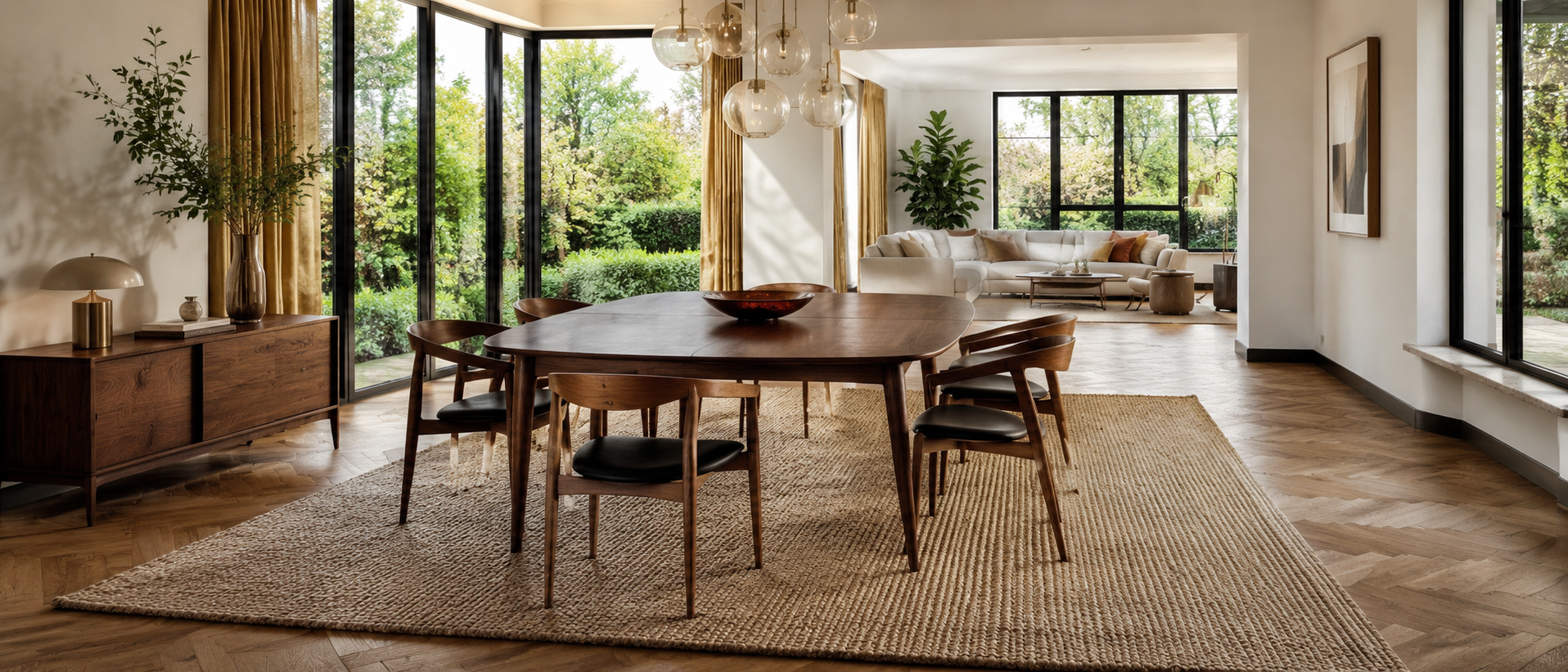
Every time someone gets up from the table, the chair travels backwards. On average, that movement covers 50 to 60 cm. If your rug ends before the chair legs do, the back feet drop onto bare floorboards. The rug edge catches, starts to curl upwards, and very quickly becomes a tripping hazard. That one moment of standing up is, in fact, the whole reason rug sizing matters at all under a dining table.
The same logic applies on all four sides simultaneously. Opposite you, beside you, across from your guests: every seat pushes back the same way. A rug that is generous on two sides but short on the other two creates exactly the same problem as one that is too small all around.
A common compromise people reach for is placing the front chair legs on the rug and leaving the back legs on the floor. This puts the chair on two different levels. It rocks, the rug edge rolls up under daily use, and the floor underneath gets scratched by the back feet. The fix is straightforward: enough overhanging edge on every side.
The 60 cm rule: the minimum that actually works
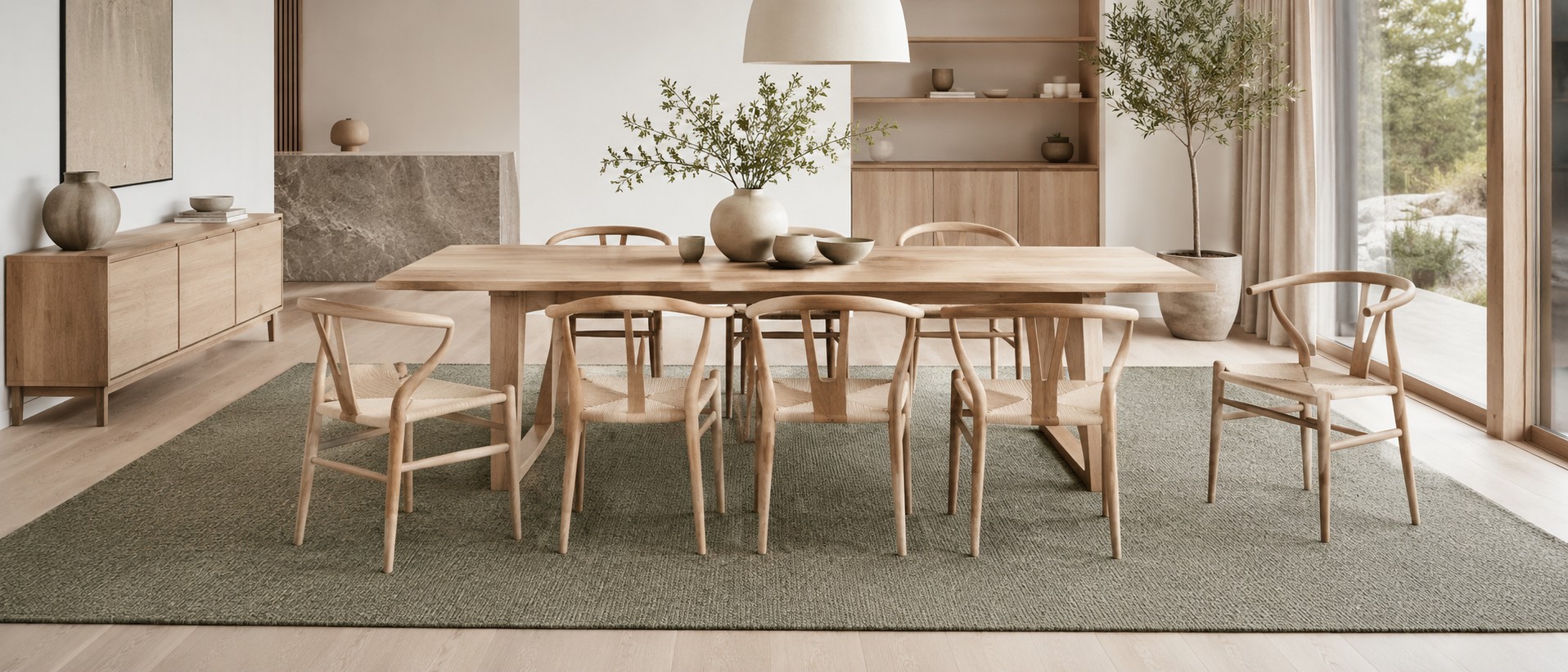
The 60-cm rule is the most consistently cited benchmark across independent rug guides: the rug should extend at least 60 cm beyond the table edge on each of the four sides. That figure maps closely onto average chair depth, which means a pulled-back chair stays entirely on the rug rather than bridging the edge.
Sixty centimetres is calibrated for standard dining chairs without armrests. If your seats are wide armchairs or deep upholstered chairs, the Stuhltiefe (seat depth) is greater, so the overstand should rise to 75 to 80 cm. Some retailers, including Höffner, recommend 75 cm as a blanket minimum. That is the more comfortable target; for slimmer chairs it is generous rather than essential.
When in doubt, measure your actual chair: from the back leg to the front leg and add 15 cm. That gives you a tailored Überstand rather than a round-number guess.
The formula: your table measurement plus twice the overhang
The arithmetic is the same for any table. Take your Tischmaß and add the overhang twice over, because the rug must extend on both the near and far sides:
- Rug length = table length + 2 × 60 cm (i.e. table length + 120 cm)
- Rug width = table width + 2 × 60 cm (i.e. table width + 120 cm)
Worked example: a table measuring 160 × 90 cm. Length: 160 + 120 = 280 cm. Width: 90 + 120 = 210 cm. You need a rug of at least 280 × 210 cm.
For a round table, add the double overhang to the diameter. A table with a diameter of 120 cm calls for a rug diameter of at least 240 cm (120 + 60 + 60).
An extendable table should always be calculated at its maximum length. If you size the rug to the folded-down dimension, every extra chair you add for a dinner party will sit with its back legs on the floor. That repeated rolling over the rug edge damages the fibres over time and creates an uneven surface for your guests.
Size table: common table formats and the rug they need
The table below shows minimum rug dimensions at 60 cm overhang per side for typical dining table sizes. If you have armchairs or wide upholstered seats, move up to the next standard size.
| Table size | Seats | Minimum rug size (60 cm overhang) |
|---|---|---|
| 120 × 80 cm | 4 | 240 × 200 cm |
| 140 × 90 cm | 4 to 6 | 260 × 210 cm |
| 160 × 90 cm | 6 | 280 × 210 cm |
| 180 × 90 cm | 6 | 300 × 210 cm |
| 180 × 100 cm | 6 to 8 | 300 × 220 cm |
| 200 × 100 cm | 8 | 320 × 220 cm |
| Ø 120 cm (round) | 4 | Ø 240 cm |
One more measurement worth checking: leave at least 20 to 30 cm between the rug edge and the nearest wall, sideboard, or door swing. A rug that runs flush against furniture compresses the room visually and can obstruct doors.
Round or rectangular: matching the rug shape to your table
The simplest rule is to echo the table. A rectangular table and a rectangular rug produce even overhang on every side, with no corners pushing further into the room than necessary. A round table pairs naturally with a round rug, and the same formula applies: diameter plus 120 cm.
Placing a round rug under a rectangular table is possible, but the diameter has to be large enough to cover the long sides of the table with the full 60 cm overhang. In practice that often means a very large circle whose edge sweeps deep into the room.
In an open-plan kitchen-dining space, that sweep can work in your favour. A large round rug defines the dining zone with a softer boundary than a hard rectangle. The condition is straightforward: enough floor space to absorb the radius without the rug overlapping into the kitchen or living area.
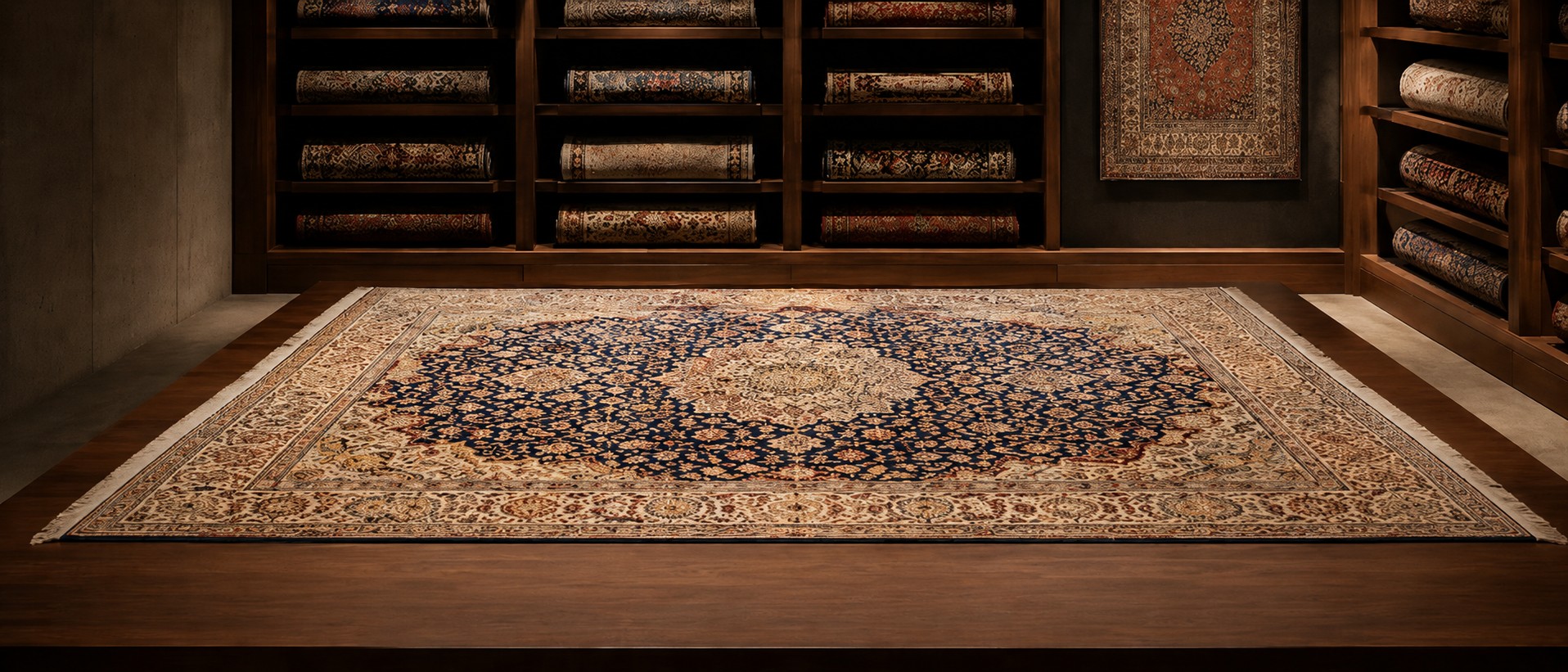
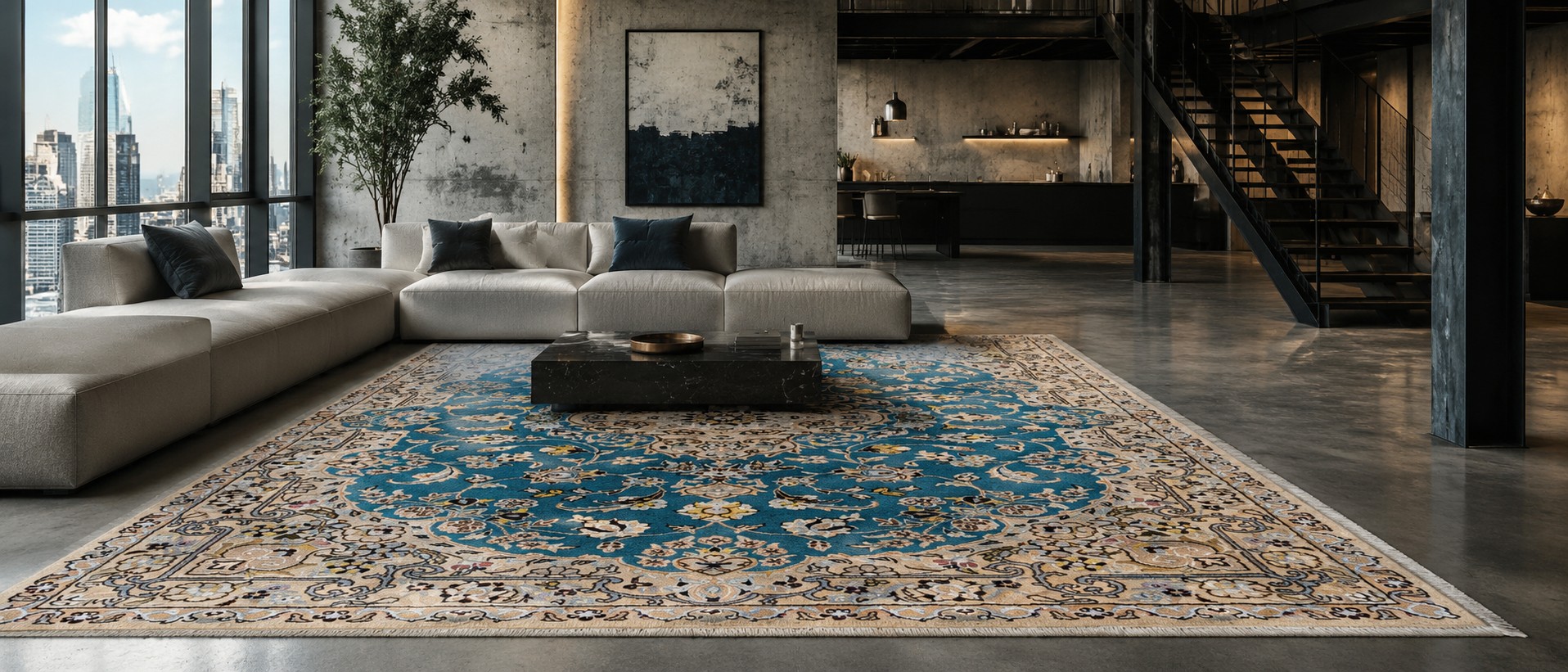
One design detail worth knowing: because the central portion of the rug stays permanently hidden under the table and chairs, the border becomes the visible face of the design. A strong edge pattern, a coloured border, or a contrasting frame reads well in a dining room precisely because it is always in view.
Material: what actually survives daily life under a dining table
The area beneath a dining table is one of the hardest-working spots in any home. Chair legs drag across it multiple times a day, crumbs settle into the weave, and liquid spills happen regularly. The material needs to absorb all of that without deteriorating.
Good choices:
- Flatweave: No upright pile, so nothing for crumbs to hide in. Chairs slide easily, and cleaning is straightforward. This is the most practical option for heavy use.
- Kurzflor (short pile) up to 10 mm: Still easy to maintain and noticeably softer underfoot than a flatweave. The independent Swiss consumer testing service K-Tipp recommends a maximum pile height of 5 mm for dining areas; up to 10 mm is workable in everyday use.
- Polypropylene (PP): A synthetic fibre built for resilience. It resists moisture, wipes clean after spills, and was originally developed for outdoor use, which tells you something about its durability indoors.
- Short-pile wool, tightly woven: A solid option if you vacuum regularly and deal with spills promptly. Dense construction keeps the pile upright under chair pressure. Long-pile wool, by contrast, is not suited to this location.
Materials to avoid:
- High pile / shaggy rugs: Chair legs press permanent indentations into deep pile, crumbs become almost impossible to remove fully, and every meal adds to the cleaning effort.
- Viscose: Reacts badly to moisture, loses its sheen quickly, and can distort permanently after a single significant spill.
- Fringed edges: Fringe gets caught under chair legs repeatedly. It frays, it becomes a trip hazard, and it looks worn within months of daily use.
Anti-slip underlay and chair glides: two small decisions with outsized effects
An anti-slip underlay is worth including from the start. Every time a chair is pulled back, the rug experiences lateral force. Without an underlay, the rug gradually migrates, buckles, and forms ridges. With one, it stays flat and in place. The underlay also cushions the floor beneath and reduces wear on the rug backing over time.
If your floor is vinyl or LVT, choose a plasticiser-free underlay. Standard rubber-backed underlays can react chemically with vinyl flooring and leave permanent staining or surface damage.
For chair glides on a short-pile rug, choose plastic, Teflon-coated, or stainless steel feet. These surfaces slide smoothly over the pile without snagging. Felt glides, which work well on hard floors, tend to grip the fibres of a rug and make the chair noticeably harder to move, while also pulling at the weave over time.
FAQ
How large does a rug under a dining table need to be?
Add 60 cm to every side of your table. The formula is: table length + 120 cm = rug length, table width + 120 cm = rug width. A 180 × 90 cm table therefore needs a rug of at least 300 × 210 cm. If you have armchairs or wide upholstered seats, increase the overhang to 75 to 80 cm per side.
What is the 60 cm rule for dining table rugs?
The 60-cm rule states that the rug must extend at least 60 cm beyond the table edge on each of the four sides. The reason is chair movement: when someone stands up, the chair travels roughly 50 to 60 cm backwards. With 60 cm of overhang, all four chair legs remain on the rug throughout that movement. For deeper armchairs, 75 to 80 cm is the more comfortable figure.
Which rug size do I need for a 160 × 90 cm table?
A table measuring 160 × 90 cm requires a rug of at least 280 × 210 cm. The calculation: 160 + 120 = 280 cm for the length, 90 + 120 = 210 cm for the width. If your chairs have armrests or you simply want more breathing room, the next standard size up, for example 300 × 240 cm, gives a noticeably more comfortable result.
Can I use a round rug under a rectangular dining table?
Yes, but the diameter must be large enough to provide the full 60 cm overhang along the long sides of the table. In practice, this often results in a very large circle. As a general principle, rug shape follows table shape: a rectangular rug under a rectangular table keeps the overhang even on all sides with no excess pushing into the room. A round rug under a rectangular table works best in open-plan spaces where there is plenty of floor area around the dining zone.
Which material works best under a dining table?
Flatweave: No pile to trap crumbs, easy to clean, chairs slide freely. Short pile (Kurzflor) up to 10 mm: Practical and comfortable underfoot; consumer tests recommend staying at or below 5 mm for dining areas. Polypropylene (PP): Moisture-resistant, hard-wearing, and simple to wipe clean after spills. Avoid: High pile (traps debris, holds chair indentations), viscose (moisture-sensitive), and fringed edges (trip hazard under chairs).