Asymmetric Knots in Rugs: What the Senneh Knot Really Means
The product description says "asymmetric knot", and you are wondering what that actually means. In short: it is not about the pattern, but about the way the pile thread is looped around the warp threads. Once you have understood this, you will read every rug description with fresh eyes. So let us go through it step by step.
What Happens to the Pile Thread with the Asymmetric Knot
A hand-knotted rug consists of three components: vertical warp threads, horizontal weft threads, and the pile, which forms the visible surface. The knot is the point at which the pile thread is looped around the warp threads and thus held in place.
With the asymmetric knot, exactly this happens: the wool thread is looped around two warp threads, but only one warp thread is fully encircled. The adjacent thread is only partially enclosed. One end of the yarn is pulled upwards between the warp threads, and the other end runs freely alongside. Hence the name: the knot is simply not symmetrically constructed.
Technically speaking, the pile thread is initially laid in the same way as with the Turkish knot. However, it is then not looped over the second warp thread but pulled upwards beneath it. The free end can emerge to the right or left of the warp thread. One then speaks of a knot that opens to the right or to the left. In Persian rugs, the knot most often opens to the left; in Turkmen rugs, it frequently opens to the right.
Senneh Knot, Persian Knot, Sennehbaff: The Same Technique, Many Names
For one and the same technique there is a whole range of names. Asymmetric knot, Senneh knot, Persian knot, Farsibaff, Sennehbaff, and sometimes double knot: all of these refer to the same thing. Confusing, but useful to know when you encounter these names in a description.
And here lies a persistent misconception. The name "Senneh" sounds as though the rug comes from the city of Senneh (today Sanandaj). That is, however, not the case. In Senneh itself, the tradition was to knot with the symmetric knot, not the asymmetric one. Why the technique still bears the city's name remains unexplained to this day. What is certain is that the knot was not invented in Senneh and is not limited to Persia.
The knot names therefore have no fixed geographical reference. They were historically assigned to certain provenances. The technique itself is found wherever rugs are knotted by hand. It is frequently associated with the Persian rug, but that does not make it proof of origin.
The Symmetric Ghiordes Knot in Direct Comparison
Alongside the asymmetric knot there is the symmetric knot, also called the Turkish or Ghiordes knot. With the symmetric knot, the pile yarn is placed between two warp threads, guided around one and then around the other, and both legs of the knotting thread fully encircle the warp threads. The construction is thus even on both sides.
Both techniques are purely hand-knotting methods. Some regions even use both types of knot, occasionally within one and the same rug. Here is an overview:
| Feature | Asymmetric Knot | Symmetric Knot |
|---|---|---|
| Other names | Senneh knot, Persian knot, Sennehbaff | Ghiordes knot, Turkish knot |
| Encirclement | One warp thread fully, the other partially | Both warp threads symmetrically and fully |
| Typical design | Often fine, flowing lines and floral details | Frequently bold, geometric forms |
| Quality statement | Not inherently superior | Not inherently inferior |
| Identification | On the reverse, usually one loop visible above the warp thread | On the reverse, usually two loops visible |
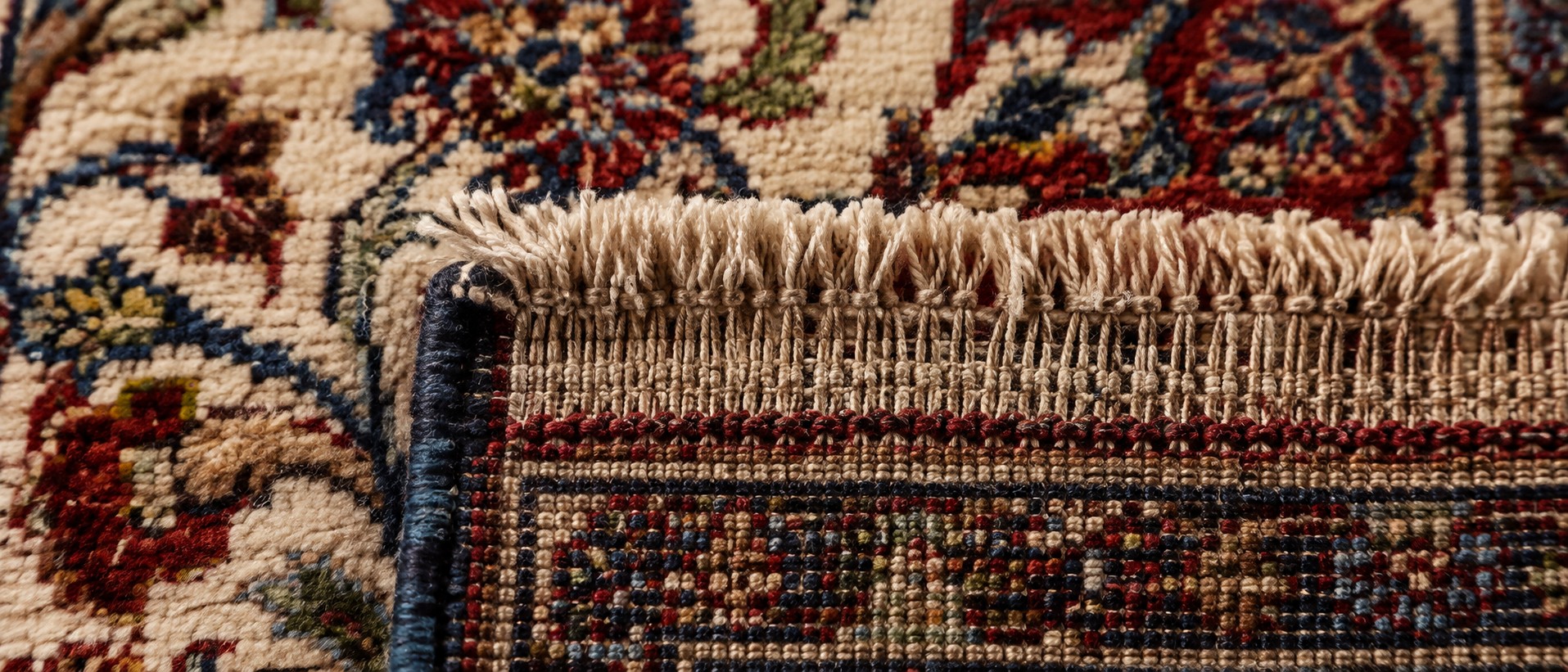
If you want to check for yourself: open the pile carefully at a right angle to the warp threads, against the direction of the nap, so that the base of the knot is exposed. If you see only one loop above the warp thread, it is most likely the Senneh knot. If two loops are visible, that points to the Ghiordes knot. In a hand-knotted rug, you can clearly make out the individual knots and the pattern on the reverse. If every row of knots is perfectly regular, that is more indicative of machine production.
For context: old rugs from western Persia such as Tabriz, Heriz, Bidjar, Hamadan, and Ferahan are knotted in the Turkish knot. The knot therefore says nothing categorical about "genuine" or "not genuine".
Why Fine Floral Patterns Often Emerge with the Persian Knot
The asymmetric knot is often associated with detailed, curvilinear, and floral designs. The reason lies in the freedom of construction: because only one warp thread is fully encircled, soft, flowing lines are somewhat easier to achieve. Think of a detailed floral medallion from Isfahan: such sweeping arabesques often come more readily with the Persian knot than with a strictly symmetric binding.
The Turkish knot, by contrast, is frequently found in geometric, sometimes bold patterns. A tribal rug with clear, angular forms is a good example of this. That is, however, a tendency, not a fixed rule. Pattern, material, knot density, and the skill of the weaver all play a part in the end result.
Both Knots Are Equal in Quality
Now the question that most people are really asking: is a rug with an asymmetric knot of higher quality? The answer is a clear no. Symmetric and asymmetric are absolutely equal in quality. With either knot it is possible to knot coarsely or superfinely, firmly or loosely, with a high or low pile. Neither is "better"; the two are expressions of different traditions.
The knotting technique is therefore not a quality seal on its own. For the overall quality of a wool rug, many factors count together: knot density, material and yarn quality, dyeing, pile, workmanship, the edges, and the evenness.
A second look at knot density is also worthwhile. The figures range from approximately 50,000 to 150,000 knots per square metre for sturdy nomadic rugs, through 250,000 to 500,000 for good workshop rugs, up to well over a million for the finest pieces from Nain, Isfahan, or Qum. But more knots does not automatically mean better. The density must suit the style. A geometric nomadic pattern does not need a million knots; a detailed floral medallion does. And there are so-called "blenders": rugs with a high knot density for which cheap yarn or old wool was used. Despite dense knotting, they wear out quickly. Knot density can sensibly be compared only within a given provenance.
What the Jufti Knot Saves and Why That Weakens the Pile
A special case is the Jufti knot. It is knotted around four warp threads instead of two. This is considerably faster and saves material and time. The price for this: the pile becomes less resilient and the rug less durable.
The Jufti knot frequently appears in large plain-coloured areas, for example in some Khorassan rugs, where a uniform surface needs to be filled quickly. The Jufti is regarded as a knot of lesser quality for exactly this reason: a shortened working process and a thinner substance. A good reason to look more closely at large plain-coloured sections.
How Long a Hand-Knotted Rug Takes to Produce
Finally, a calculation that makes the effort tangible. An experienced weaver manages on average around 10,000 knots per day. A Persian rug measuring 300 x 400 cm with a knot density of 500,000 knots per square metre thus requires approximately 600 days of pure knotting work.
That puts a great deal into perspective. A hand-knotted rug has been created by hand over months, knot by knot. The asymmetric knot is one element among many: it explains how the craft works and helps you to assess a rug with expertise. For an overall judgement, it is best to look at the interplay of technique, material, density, and workmanship.
FAQ
Is the Senneh knot the same as the Persian knot?
Yes, they are the same technique. Senneh knot, Persian knot, Farsibaff, and Sennehbaff are all names for the asymmetric knot. With it, only one warp thread is fully encircled, while the adjacent one is only partially enclosed. The many names arose historically and all refer technically to the same knotting method.
Is a rug with an asymmetric knot automatically of higher quality?
No. The symmetric and the asymmetric knot are equal in quality. With either it is possible to knot coarsely or superfinely. For quality, many factors count together: knot density, material, yarn quality, dyeing, pile, workmanship, and edges. The knotting technique alone is not a quality seal.
What is the difference between the Jufti knot and the Senneh knot?
The Senneh knot is knotted around two warp threads; the Jufti knot around four. The Jufti is therefore faster and saves material, but makes the pile less resilient and the rug less durable. That is why the Jufti knot is regarded as a knot of lesser quality, whereas the Senneh knot is a regular, equivalent knotting technique.
Does the asymmetric knot make patterns finer?
It can support fine, flowing lines and floral details, for example in a sweeping medallion. However, a rug does not automatically become finer as a result. Very high-quality pieces are also created with the symmetric knot. Fineness depends on knot density, material, pattern, and the skill of the weaver, not on the type of knot alone.
How many knots can a weaver tie in a day?
An experienced weaver manages on average around 10,000 knots per day. A rug measuring 300 x 400 cm with 500,000 knots per square metre therefore requires approximately 600 days of pure knotting work. This shows how much handwork goes into a hand-knotted rug.