Runner in the Hallway: the Right Size in Centimetres
The Visible Floor Border Makes the Hallway: 10 to 20 cm per Side
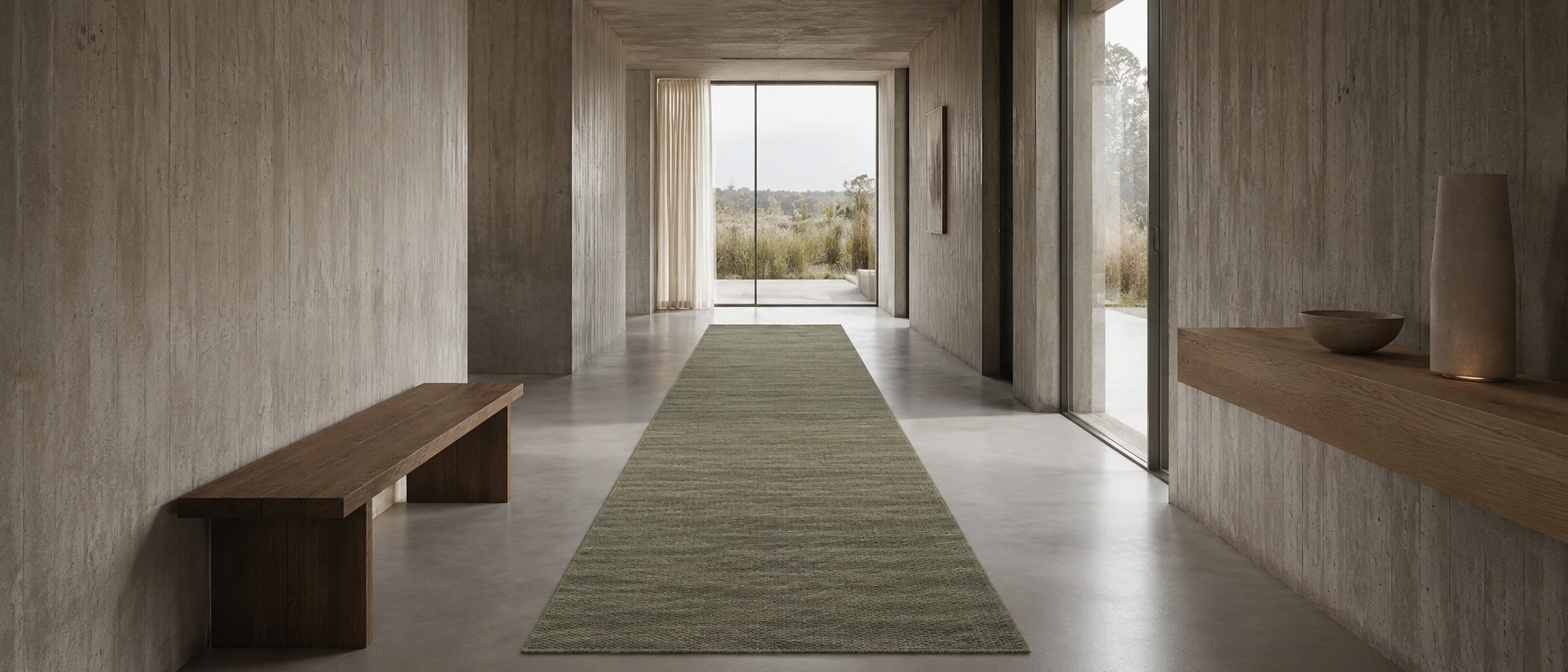
Before you even think about the width of the runner, look at the floor to the right and left of it. That narrow strip is exactly what determines whether your hallway feels airy or cluttered. As a guideline, leave between 10 and 20 cm of floor free on each side. In very narrow hallways, 15 cm per side is also sufficient to give the space a structured look.
The reason is simple: a runner that reaches from wall to wall compresses the hallway visually. The visible border, on the other hand, gives the eye room and draws the line lengthwise. That is why you measure the hallway width first and subtract the side border before determining the appropriate runner width.
Width According to Hall Dimensions: 60 to 70 cm Narrow, 90 to 100 cm for the Entrance Hall
The width follows almost automatically from the floor border. For narrow hallways under 100 cm, your best choice is 60 to 70 cm. The classic 80 cm is often already too wide here and makes the hallway feel cramped. For a hallway width of 120 to 150 cm, 70 to 80 cm is the right fit.
A reliable rule of thumb: the runner should take up approximately one third to half of the hallway width. For wide entrance halls from 150 cm, models from 100 cm make sense without the space appearing overloaded.
- Hallway under 100 cm: runner 60 to 70 cm
- Hallway 120 to 150 cm: runner 70 to 80 cm
- Entrance hall over 150 cm: runner from 100 cm
An example: in a wide entrance hall of 180 cm, a runner from 100 cm fills the area pleasantly, and enough floor remains visible on both sides.
Centred Placement Makes the Hallway Look Larger than Against the Wall
The runner belongs in the centre of the hallway, with an equal gap to both walls of approximately 10 to 15 cm per side. If you place it directly against a wall, the hallway looks narrower and more confined than it actually is.
The doors are equally important. The front door should be able to open without dragging across the runner, and all interior doors at the ends must also be able to swing freely. Check this with a door-swing test before deciding on a size.
The Right Length: Hall Measurement Minus 30 cm or 80 to 90 Per Cent
For the length, measure the hallway in full and subtract around 30 cm. In typical home hallways, this puts you between 200 and 300 cm. Alternatively, you can calculate 80 to 90 per cent of the total hallway length; the result is similar.
Common standard lengths are 200, 250 and 300 cm. For very long hallways, 350 cm or custom sizes up to 4 metres as a single continuous piece are also available. Importantly, floor should remain visible at both ends, between 30 and 120 cm depending on the situation.
If your hallway is shorter than 2 metres, consider a square doormat instead of a long rug runner. Two short runners placed one after the other usually look like a plan B and rarely appear convincing. In small hallways, lengths between 100 and 120 cm are also popular.
Material for High-Traffic Hallways: Polypropylene, Wool, Cotton Compared
The hallway is the most heavily trafficked strip in the home; the material must be able to withstand that. Polypropylene is considered the most robust choice for heavily used hallways: moisture-resistant, dirt-repellent and cleanable with a damp cloth. The trade-off lies in the feel, less soft underfoot and less refined in texture.
| Material | Strengths | Things to Consider |
|---|---|---|
| Polypropylene | Robust, water-repellent, easy to care for | Less soft, less refined feel |
| Wool | Robust with good quality | Not suitable for machine washing |
| Cotton | Soft, usually machine washable | For moderate use |
For a household with small children and moderate traffic, machine-washable cotton is a practical option. Delicate materials such as silk, on the other hand, are not suited to the hallway. It is also worth checking the pile height: a low pile under 10 mm makes the hallway look visually wider, while from 10 to 12 mm it can become tight when opening doors.
When the Runner Is Too Wide or Too Long: the Typical Mistakes
Chosen too wide, the runner fills the floor almost completely and the side border disappears. The hallway then feels cramped and the lengthening effect is lost. Too long usually means the runner blocks a door or the front door drags across it.
The most common placement mistake is precisely this combination: a runner that is in the way of doors or was chosen too narrow for the hallway. A tip to avoid door conflicts: subtract at least the width of the door leaf from the planned runner length, and the doors at the ends will swing freely.
To keep the runner in place on a smooth floor, an anti-slip underlay belongs underneath it. Especially in the hallway, where there is a great deal of movement every day, it holds the runner in position and prevents it from slipping and causing trips.
FAQ
How much floor should be visible on each side of the runner?
10 to 20 cm per side. In very narrow hallways, 15 cm per side is also sufficient. This visible floor border gives the hallway room and makes it look wider and longer rather than cluttered.
How wide should a runner be in a wide entrance hall?
From 100 cm. In entrance halls over 150 cm wide, you can opt for wider models without the space appearing overloaded. In a 180 cm wide entrance hall, a runner from 100 cm fills the area pleasantly, and floor remains visible on each side.
Where exactly is the runner placed in the hallway?
In the centre, with an equal gap of approximately 10 to 15 cm to both walls. Placed directly against the wall, the hallway looks narrower and more confined. Also make sure that the front door and interior doors at the ends can open freely.
Which material is suitable for high-traffic hallways?
Polypropylene is the most robust choice: water-repellent, dirt-repellent and easy to care for. Cotton is softer and usually machine washable, good for moderate traffic and households with small children. Delicate materials such as silk are not suited to the hallway.
What happens if the runner is too wide or too long?
Too wide causes the side floor border to disappear and the hallway feels cramped. Too long often blocks a door or the front door drags across it. For the length, use the hall measurement minus around 30 cm and subtract at least the width of the door leaf.