Choosing the Right Rug Size: Living Room, Dining Room, Bedroom, Hallway
Why size determines everything else
Anyone who has ever ordered a rug that was too small knows the result: the furniture looks disconnected, the room feels less settled, and the rug itself barely registers. The pattern may have been beautiful, the colour perfectly matched – and yet the overall picture falls short. This is almost always down to size.
The rug size is the one decision that cannot be corrected after the fact without replacing the rug entirely. Pattern and colour are matters of taste. Size, on the other hand, follows a clear spatial logic: a rug works when it connects furniture, covers movement zones and gives the room visual calm. This guide explains what that looks like in practice for each room type.
Measuring before you buy: furniture zone, not floor area
The first step before any rug decision is measuring correctly. What matters is the furniture zone: the area where the sofa, table or bed stands and is used, rather than the overall size of the room.
Recommended approach:
- Place furniture in its final position or mentally position it before measuring.
- Mark the desired rug area on the floor with masking tape. This shows the actual effect before the rug is ordered.
- Account for movement zones: pull out chairs in the dining room, mentally step out of bed in the bedroom, check in the living room whether the sofa and armchairs visually belong together.
- When in doubt, choose the larger standard size. If the marked area falls between two available dimensions, the larger option is almost always the better choice.
Anyone who skips this step and decides based on room size alone will frequently buy too small. The masking tape exercise takes five minutes and prevents the most common buying mistake.
Rug size in the living room: the seating group sets the scale
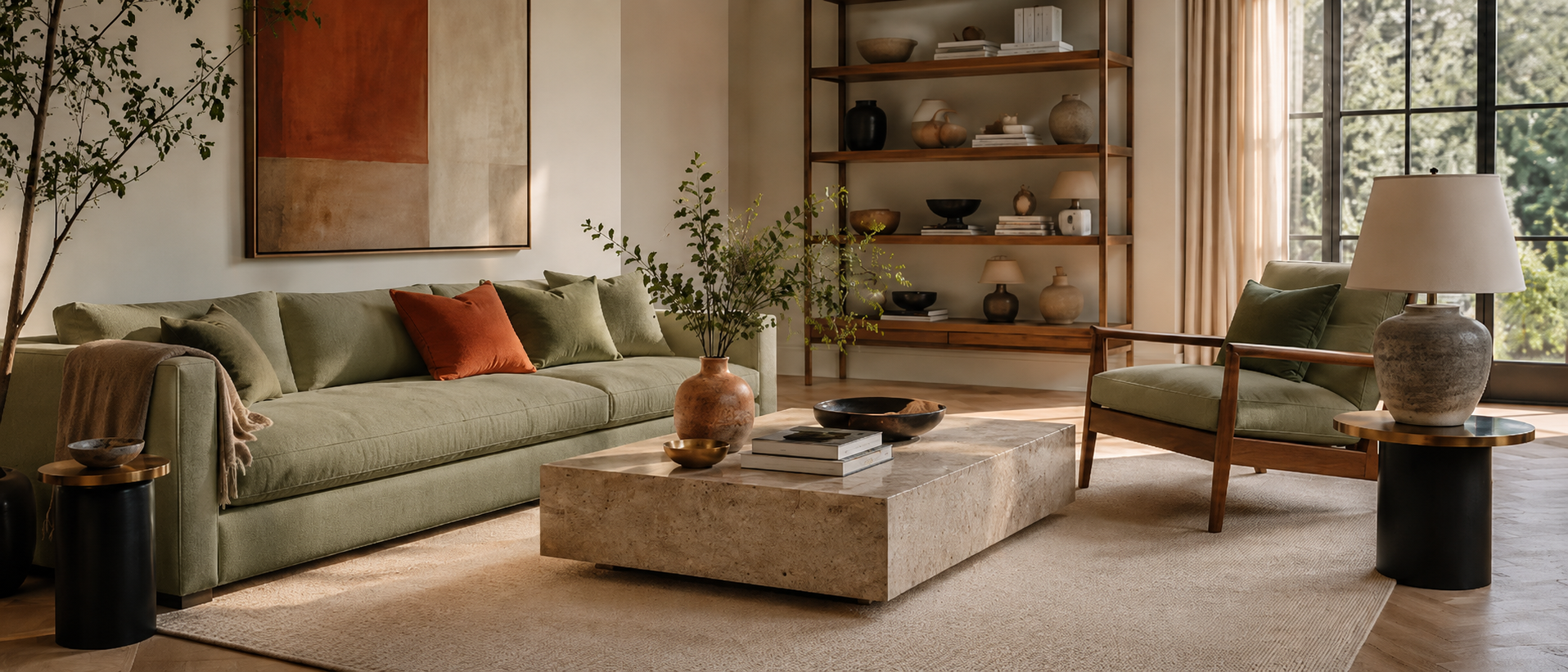
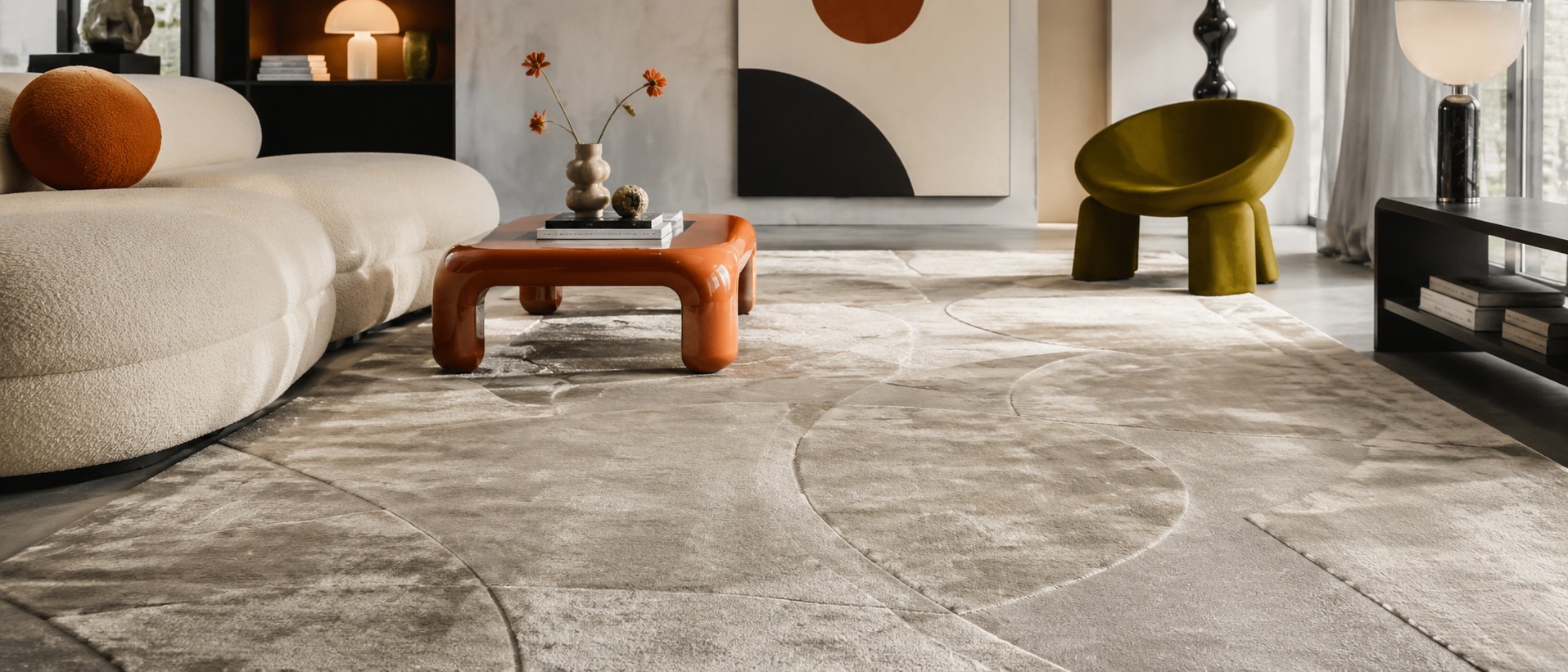
In the living room, the rug takes on a structuring role. Sofa, armchairs and coffee table should be perceived as a single unit, and that is precisely what a rug in the right size achieves.
The key rule: the rug must be wider than the sofa, and at least the front legs of all seating furniture should rest on the rug. If only the coffee table stands on the rug, the area is in almost all cases too small. The sofa and armchairs then appear detached from the focal point of the room.
Recommended standard sizes for the living room:
- 160 × 230 cm: Suitable for compact living areas with a two-seater sofa.
- 200 × 300 cm: The most balanced choice for most classic living rooms.
- 250 × 350 cm or larger: For corner sofas, large seating groups or open-plan living and dining areas.
Particular attention should be paid to the position of the rug edge. It should never end directly at furniture legs. Either the piece of furniture clearly stands on the rug or clearly beside it. An edge that bisects legs creates visual unrest.
For those deciding between two sizes: the larger rug rarely makes a well-proportioned room worse. A rug that is too small, on the other hand, affects the entire feel of the space.
Rug size in the dining room: the chair sets the scale, not the table
In the dining room, attention often falls first on the table. The actual scale, however, is set by the chair – more precisely, by the pulled-out chair. When standing up, a chair moves around 60 to 75 centimetres away from the table. This movement space must lie entirely on the rug.
If the rug is too small, chair legs tip over the rug edge or catch on it when being pulled back. This is a matter of everyday usability, not just appearance.
This gives rise to the following rule of thumb: the rug should extend around 60 to 75 cm beyond the tabletop on every side. For a dining table measuring 90 × 180 cm, this means a rug size of at least approximately 210 × 330 cm. For a table measuring 100 × 200 cm, at least 220 × 350 cm accordingly.
Further points particularly relevant in the dining room:
- With 6 to 8 chairs, significantly more area is needed than with 4 seats.
- A round rug under a round table looks harmonious, provided it is chosen large enough. A round rug that is too small under a round table amplifies the impression of insufficient area.
- Low-pile and flatweave qualities are considerably more practical in the dining room than high-pile: chairs glide more evenly, edges remain more stable, and cleaning is easier.
Rug size in the bedroom: symmetry and a soft landing
The bedroom follows different rules to the living room or dining room. Here, it is about atmosphere, the feeling of morning and calm. The rug should create symmetry and ensure that feet land softly when getting up.
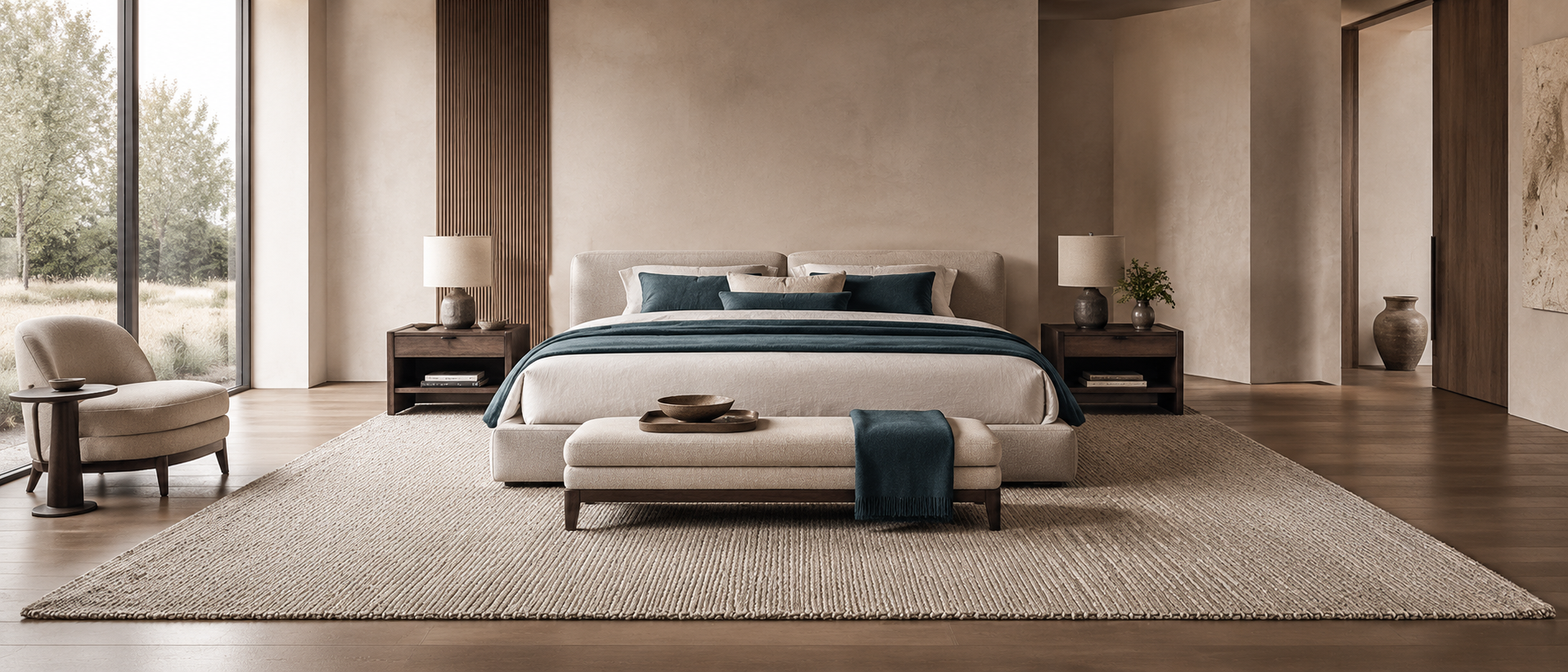
The classic approach: a large rug is slid under the bed and extends noticeably to the sides and at the foot end. A guideline of around 45 to 60 cm of visible overhang on each side applies. The rug is then present in the room even when the bed stands over it.
Suitable sizes for a double bed (standard 160 × 200 cm):
- 200 × 300 cm for more compact bedrooms with the bed centred against the wall.
- 250 × 350 cm for more generous rooms or when a wider overhang is desired.
Anyone who prefers not to place a large format under the bed can choose two runners: one on each side. Importantly, the runners must be long enough for feet to land entirely on the rug when getting up. A runner that covers only the middle section beside the bed misses its purpose.
Material and texture play a greater role in the bedroom than in other rooms. A soft wool rug or a quality with a pleasant surface makes the moment of getting up noticeably more comfortable.
Hallway runners: guiding, proportioning, protecting
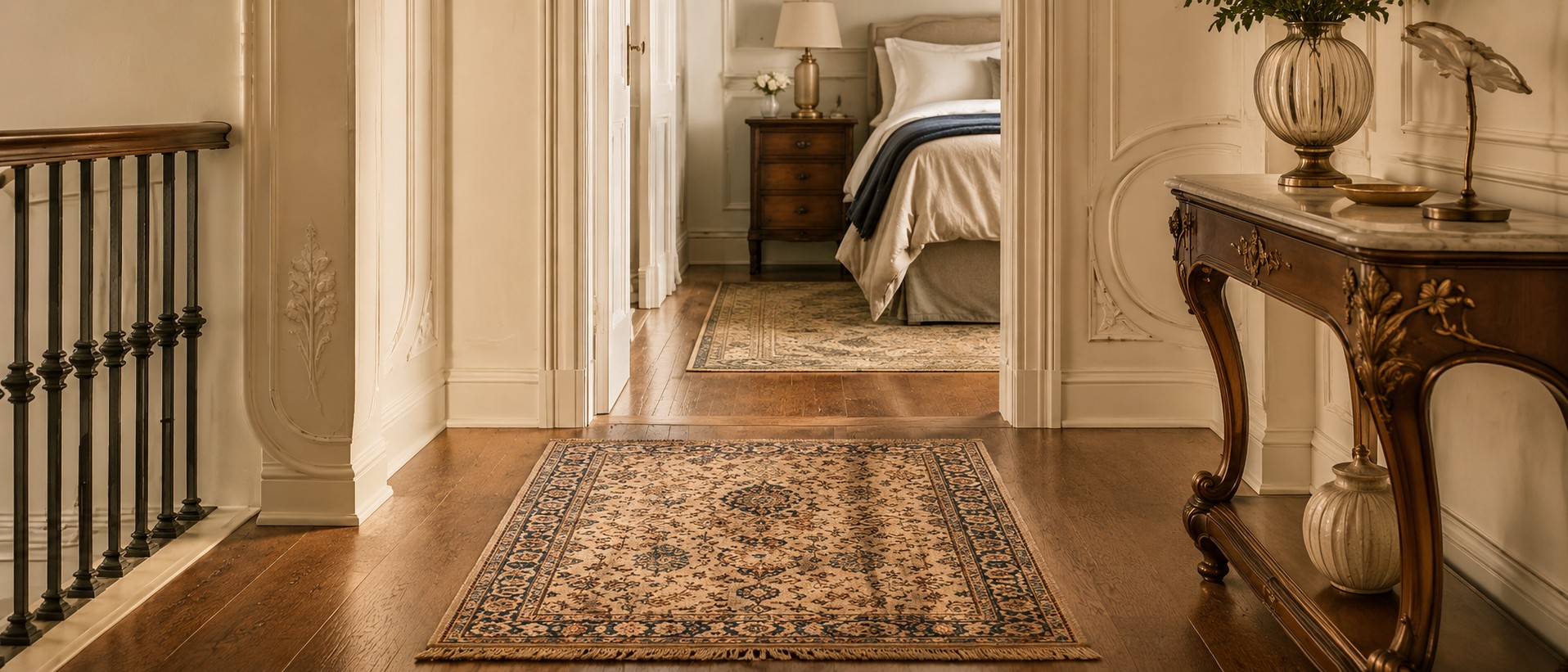
The hallway has its own requirements: everyday practicality, slip resistance and correct proportioning are decisive. A runner that looks like a narrow strip misses its purpose. It should visually structure the corridor without dominating it.
Guidelines for the hallway:
- Side clearance: Leaving around 10 to 15 cm of visible floor on both sides makes the hallway look orderly.
- Length: The runner should accentuate the corridor along its full length and reach as close as possible to walls or door frames.
- Check the door swing: Doors must be able to open freely. Choosing a thick high-pile runner risks doors dragging or jamming.
- Material: For entrance areas and heavily used hallways, flat, robust qualities that are easy to clean are most suitable.
- Anti-slip underlay: On parquet, tiles or polished stone, a non-slip underlay is essential. Runners without fixation shift with every step.
In the hallway, a rug that slips or wears out after a few months has not fulfilled its purpose. The combination of the right width, a robust quality and a secured underlay is the best foundation.
The most common mistakes when buying a rug
Certain misjudgements recur particularly often. This list helps to avoid them from the outset:
- Sizing the rug solely by the coffee table rather than the entire seating group.
- Choosing a dining room rug without sufficient allowance for pulled-out chairs.
- Choosing a bedroom rug so small that it almost entirely disappears under the bed and barely has any effect.
- A hallway runner that blocks doors or is too narrow for the corridor.
- High-pile in heavily used areas such as the dining room or hallway, which is difficult to clean.
- A round rug under a round table chosen too small, which amplifies the effect.
- No anti-slip underlay planned for runners on smooth surfaces.
- The rug edge ends exactly at furniture legs rather than clearly beneath or beside them.
Almost all of these mistakes can be avoided with five minutes of masking tape on the floor. Making the furniture zone visible before buying leads to more confident decisions.
Quick overview: guidelines by room type
For those looking for a compact reference:
- Living room: Rug wider than the sofa, front legs of all seating on the rug surface. Common sizes: 160 × 230 cm, 200 × 300 cm, 250 × 350 cm.
- Dining room: 60 to 75 cm more than the tabletop on all sides, so chairs remain on the rug when pulled back. Prefer low-pile.
- Bedroom: 45 to 60 cm of visible overhang at the sides and foot end. Common sizes for double beds: 200 × 300 cm or 250 × 350 cm.
- Hallway and corridor: 10 to 15 cm of floor clearance on both sides, doors must be able to swing freely, flat quality for heavily used areas, plan for an anti-slip underlay.
These guidelines are points of orientation. What always remains decisive is the specific furniture arrangement, the available space and the desired effect. Anyone who understands the logic behind the sizes will also find the right solution for unusual room layouts.
FAQ
How do I find the right rug size for the living room?
The rug must be wider than the sofa. At least the front legs of the sofa and armchairs should rest on the rug. 160 × 230 cm for smaller rooms with a compact sofa. 200 × 300 cm for most classic living rooms. 250 × 350 cm or larger for corner sofas or large seating groups. When in doubt: go one size up, so the seating group reads as a single unit.
What dimensions does a rug under the dining table need?
The rug should extend around 60 to 75 cm beyond the tabletop on every side. Chairs must remain fully on the rug even when pulled back, otherwise legs tip over the edge. Example: a table measuring 90 × 180 cm requires a rug of at least approx. 210 × 330 cm. Low-pile or flatweave qualities are more practical than high-pile: easier to clean and chairs move more evenly.
Can a bedroom rug be used by allergy sufferers?
Rugs made from natural fibres such as wool are generally well tolerated when maintained regularly. For the bedroom, the guideline is: approx. 45 to 60 cm of visible overhang at the sides and foot end of the bed. For a double bed (160 × 200 cm), 200 × 300 cm or 250 × 350 cm are suitable. Alternatively, two runners placed to the left and right of the bed, long enough for feet to land fully when getting up. Soft materials with a pleasant texture make the morning moment noticeably more comfortable.
What width is right for a hallway runner?
Around 10 to 15 cm of floor should remain visible on both sides so the hallway looks orderly. The length should accentuate the corridor and reach as close as possible to walls or door frames. Doors must be able to open without obstruction: high-pile runners can block doors. Flat, robust qualities are most suitable for heavily used entrance areas. An anti-slip underlay is essential on smooth surfaces.
What are the most common buying mistakes with rugs?
The rug is chosen too small because only the coffee table is used as a reference rather than the entire seating group. In the dining room, the necessary overhang for pulled-out chairs is missing. In the bedroom, the rug almost entirely disappears under the bed. In the hallway, the runner blocks doors or looks too narrow for the corridor. No anti-slip underlay has been planned. Solution: mark the desired rug area on the floor with masking tape before buying. This makes the actual effect visible and prevents almost all of these mistakes.