Removing pressure marks from rugs: the quickest methods for furniture indentations
Dent discovered: what helps, and in which order
You moved the sofa for the weekend and underneath you find three deep foot indentations. They need to be gone by tomorrow. No drama, there are several ways to tackle this, and it is best to start with the easiest.
The order is simple: first the quick test with vacuuming and brushing, then the ice cube method, followed by steam with the iron. Only if all of that is not enough does the steam cleaner come into play. This saves you effort if the dent is only superficial anyway. And you will learn straight away which method suits your rug, because wool and synthetic fibres react differently.
The good news upfront: in most cases you do not need to buy a new rug. Removing pressure marks from rugs is hands-on work, but it is manageable.
Why furniture leaves dents in rugs in the first place
Pressure marks form because the fibres are compressed over a longer period and settle differently from how they were intended. When a heavy piece of furniture stands in one spot for a long time, the rug is pressed down more and more. With high-pile rugs this is more noticeable, because the longer pile fibres are more prone to flattening.
The shape of the furniture legs also plays a role. Narrow or thin legs concentrate all the weight onto a small area, which makes the indentation deep. In addition to the fibres, the backing of the rug is also compressed, which further reduces the volume.
A word on expectations: the longer the furniture has been standing there, the harder it is to lift the indentation. A bookcase that stood in the same spot for two years often leaves a stubborn dent when you move it. Very old or very deep marks sometimes only partially recover, because the fibres have taken on a permanent shape. That is the realistic limit.
The quickest test first: vacuuming and brushing for light indentations
Before you reach for ice or steam, try the cost-free approach. With light dents, the fibres sometimes lift again simply through intensive vacuuming or brushing, without any moisture at all.
- Set the vacuum cleaner to a high suction level.
- Run it over the area several times, from different directions.
- With a rug brush, work continuously over the indentation until a result is visible after a few minutes.
Always start with the gentlest option. Vacuuming, combing and brushing often lift the compressed fibres enough that the area is no longer noticeable in normal light. If that is sufficient, you are done. If not, move up one level.
The ice cube method step by step
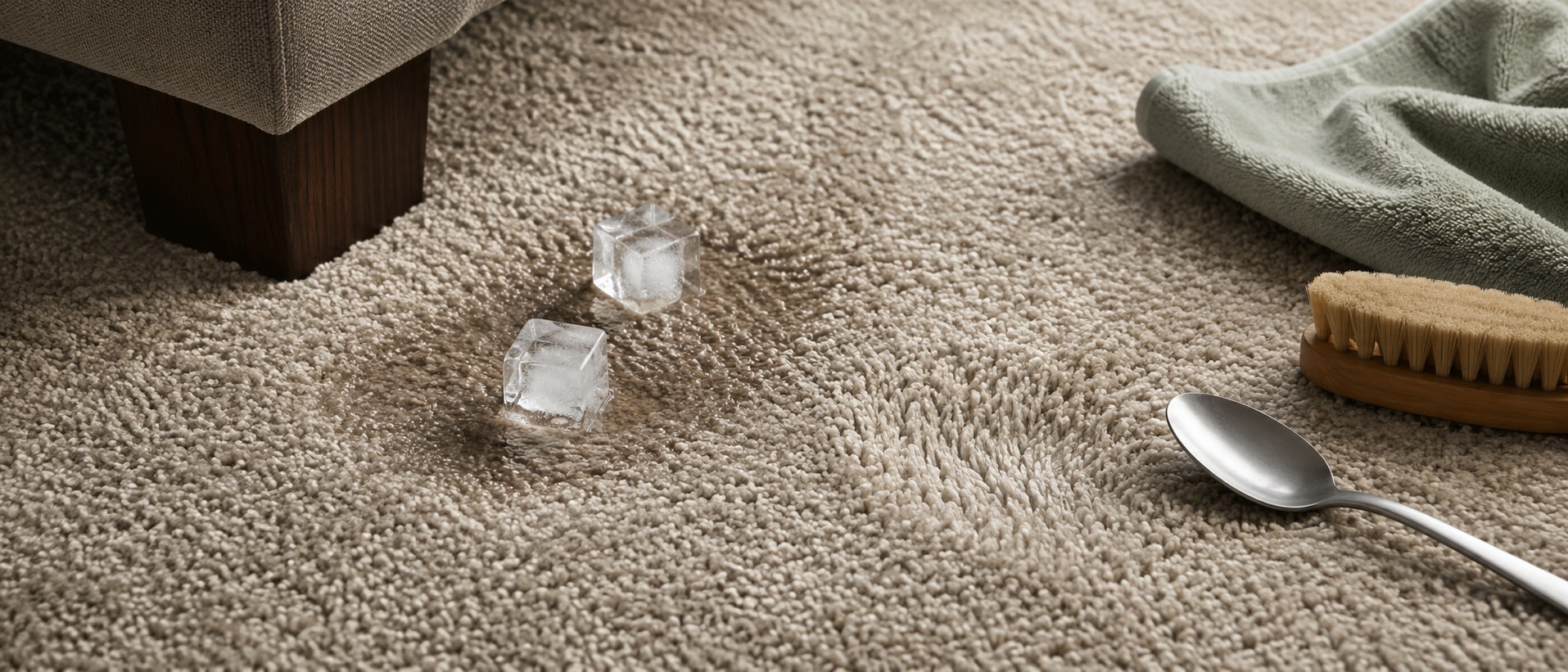
The ice cube method is the classic approach, because it costs nothing and can hardly cause any damage. The combination of cold and melt water causes the fibre to swell, so that it lifts back up to the level of the surrounding area.
This is how you proceed:
- Place ice: Put an ice cube on the pressure mark. For larger indentations, distribute several cubes approximately 1 to 2 cm apart. For round indentations from sofa legs, place the cubes along the edges of the circle.
- Allow to melt: Leave the ice to work. Depending on the depth of the dent, this takes several hours, up to 12 hours for deep marks.
- Blot: Blot any excess water with an absorbent cloth or sponge. The rug does not need to be completely dry at this stage.
- Dry: To finish, you can dry the area with a hair dryer.
- Lift: Use a coin or a spoon to lift the flattened fibres back up.
Two tips that make the difference: on light-coloured rugs, use distilled water for the ice cubes so that no limescale marks are left behind. And if the rug is on a hard floor, place a cloth underneath first so that no moisture seeps into the underlay or the floor. With delicate rugs, it is best to test on an inconspicuous corner first.
The steam method with the iron and its limits
If ice is not enough, steam is the next step. The steam function loosens the pile fibres and allows them to lift again. The important point: the hot iron must never touch the rug directly, otherwise the fibres will burn.
- Place a clean, damp cotton cloth directly on the pressure mark.
- Hold the steam iron above it at a distance, approximately 1 to 3 cm depending on the thickness of the rug.
- Activate the steam function for a few seconds.
- Remove the cloth and gently brush the fibres against the grain with a soft brush or fork.
- Allow the area to dry completely in the air before putting any weight on it again.
Now for the limit, and this is important: this method is suitable for natural fibres such as wool. A steam iron is not suitable for synthetic rugs, because polyester, nylon or polypropylene tolerate heat poorly and can be severely damaged. With synthetics, the fibres tend to crease under steam rather than recover.
And wool has its own sensitivity: too much heat or moisture can cause wool rugs to shrink or felt, and the natural, dirt-repelling wool oils can be damaged by improper treatment. So it is better to apply heat sparingly.
| Material | Ice cubes | Steam method |
|---|---|---|
| Wool / natural fibre | suitable, apply carefully | suitable, use heat sparingly |
| Synthetics (polyester, nylon, polypropylene) | suitable | not suitable, heat damage possible |
The same applies to mechanical lifting: with synthetic fibres, creases can rarely be fully repaired, and a comb can pull out individual tufts. With synthetics, gentle brushing is preferable to aggressive combing.
When nothing works immediately: multiple rounds and the steam cleaner
Some indentations do not give way on the first attempt. This is normal, especially with older marks. In that case, moisten the area thoroughly, brush it up again and repeat the process after drying. Older dents usually require several rounds, but they often disappear nonetheless.
For a very large pressure mark, for example from a sideboard that has stood in place for years, ice cubes and an iron reach their limits. Here only a steam cleaner helps, working evenly over a larger area. And the realistic expectation remains: very deep, old indentations sometimes only partially recover. A visible improvement is often achievable, but a perfectly flawless result is not always possible.
Preventing pressure marks in the first place
The easiest solution is the one you never need. Prevention is taken care of with a few simple steps.
- Gliders under furniture legs: Pads under sofas, bed frames or shelving units distribute the weight over a larger area and prevent concentrated pressure. Felt gliders are often unsuitable on rugs because they cling to the pile. For rug surfaces, gliders made of plastic, Teflon or stainless steel are more suitable, particularly on short-pile rugs.
- Move furniture occasionally: Shift heavy wardrobes, tables or sideboards a few centimetres every few months so that the pile can loosen up again.
- Prefer wider base surfaces: Furniture with wide legs distributes weight better than narrow ones.
- Allow to rest after moving: Once you have shifted furniture, leave the area flat and undisturbed so that the fibres can recover on their own.
Incidentally, you are perfectly welcome to place a table with chairs on a valuable rug. A suitable underlay protects the rug and prevents it from slipping.
FAQ
How do you remove pressure marks from a rug using ice cubes?
Place one or more ice cubes on the dent, allow them to melt, blot the water with a cloth and then lift the fibres back up using a coin or a spoon. The melt water causes the fibre to swell so that it rises back up to the level of the surrounding area. For round indentations, place the cubes along the edges; for larger areas, space them approximately 1 to 2 cm apart.
How long should the ice be left on the dent?
Depending on the depth of the pressure mark, several hours, and up to 12 hours for deep dents. Shallow indentations respond more quickly; deep ones need longer for enough melt water to soak into the fibre. If something is still visible after drying, simply repeat the process.
Does a hair dryer work instead of an iron?
A hair dryer is useful in the ice cube method to dry the area after melting. For the actual lifting with steam, however, a steam iron held over a damp cloth is needed. The hair dryer handles the drying step at the end; the steam loosens the fibres.
What should you do if a method does not work immediately?
Moisten the area thoroughly, brush it up again and repeat the process after drying. Older indentations usually require several rounds. For very large pressure marks, such as those from a sideboard, ice cubes and an iron reach their limits, and a steam cleaner will help instead.
How can you permanently prevent pressure marks in a rug?
Place furniture gliders under heavy furniture legs to distribute the weight. On rug surfaces, use gliders made of plastic, Teflon or stainless steel, as felt gliders cling to the pile. Move heavy furniture a few centimetres every few months. Prefer furniture with wider base surfaces.