Removing Wax Stains from Rugs: How to Save the Pile
Three steps, and the rug usually comes through without a problem
Candles in the living room, a relaxed evening, a brief moment of inattention: and there is the wax stain. I know it well. In my career as a rug cleaner I have seen more ruined rugs than I care to count. Almost all had one thing in common: the first instinct was wrong. Anyone who keeps their hands still in time has already won half the battle.
Candle wax can be removed cleanly from a rug in most cases. Provided you work in the correct order. The material, pile height and wax colour determine how far you will get with household remedies. I cover the rest further below.
Gathering your materials: what you need
- Ice pack or cool pack (wrapped in a cloth)
- Blunt spoon or old credit card
- Vacuum cleaner
- Kitchen paper, blotting paper or a white cotton cloth
- Iron (alternatively: hair dryer)
- Stain remover (only for coloured wax, test beforehand)
Immediate action: the first moment makes all the difference
Is the wax still soft and warm? Place a piece of kitchen paper loosely over it and wait. That is all. No wiping, no rubbing, no hot water. Soft wax yields and is pushed deeper into the fibres when touched. Wait until the wax has hardened completely; depending on room temperature this takes 20 to 60 minutes.
In a hurry? An ice pack wrapped in a cloth makes the wax brittle quickly. Brittle wax breaks off rather than pressing in. That is considerably gentler on the rug.
Mistakes to avoid at all costs:
- Rubbing or wiping warm wax
- Pouring hot water onto the area
- Spraying solvents over a large area without prior testing
- Using sharp or pointed tools
The step-by-step guide to removing wax
Step 1: Allow the wax to harden completely and cool it
Patience here is not a virtue but a necessity. Place the cool pack wrapped in a cloth on the stain to prevent condensation. The wax becomes brittle and can afterwards be lifted off mechanically much more easily.
Step 2: Lift off the bulk of the wax and vacuum it up
Using a blunt spoon or the edge of an old credit card, work from the outside inwards. Lever it off rather than scraping. Then vacuum up the wax crumbs thoroughly. No pressure, no force.
Step 3: Absorb residual wax with heat and paper
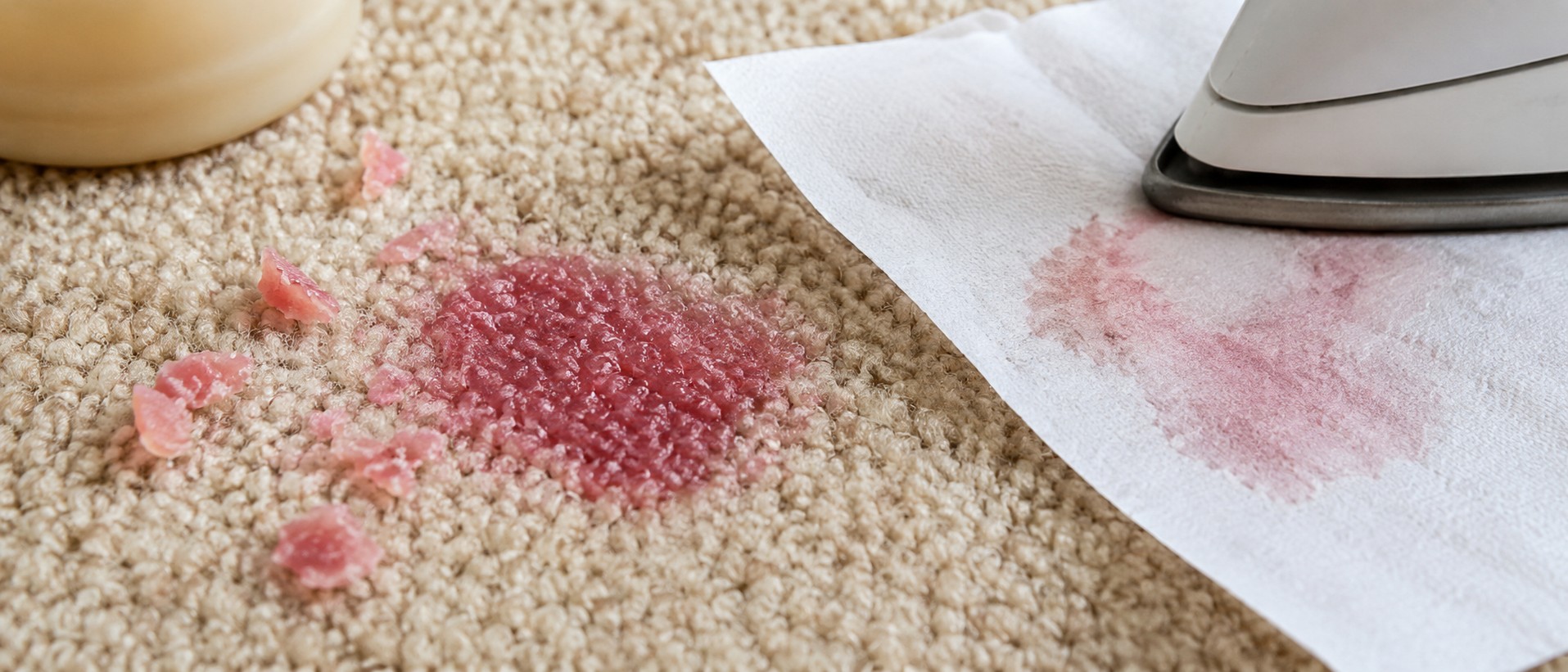
Now place several layers of kitchen paper, blotting paper or a white cotton cloth over the stain. Please avoid coloured cloths, as they can transfer dye. Set the iron to its lowest setting, always deactivate the steam function, and press briefly onto the paper. The melted wax is drawn into the paper. Use a fresh piece of paper after each pass. Continuing with saturated paper only redistributes the wax. The iron must never come into direct contact with the rug pile at any point.
Repeat until the paper remains clean after pressing. Then allow the fibres to dry and vacuum one final time.
Step 3b: Alternative using a hair dryer
No iron to hand? A hair dryer on its lowest setting does a good job. Keep some distance, warm the wax slowly and blot immediately with absorbent paper. It takes longer, but works reliably as long as you do not overheat the area.
Coloured candle wax: the special case many people underestimate
A red candle on a light dining room rug is unfortunately a category of its own. After removing the actual wax, a colour haze often remains because the dye has penetrated the rug fibre. The heat-and-paper method alone does resolve this.
For the colour residue you need a suitable stain remover. But please: always test on a hidden area first, for example under a piece of furniture. Then only blot, never rub. For valuable rugs I would clearly recommend professional cleaning at this point. I cannot promise you complete colour removal with coloured wax, and anyone who does is not being honest with you.
What the material determines about your options
Synthetic rugs (polypropylene, polyester, nylon)
Comparatively robust. The iron method works well here, provided the temperature remains on the lowest setting.
Wool rugs
Wool is sensitive to heat and chemicals. It is better to work with cold for longer here, choose particularly short contact times with the heat method and, when in doubt, consult a professional. A wool rug is more forgiving of a treatment that is too gentle than one that is too rough.
Silk and viscose
My clear recommendation: put the iron away. These materials react to heat and moisture with distortions that cannot be reversed. Professional cleaning is not a luxury here but the only sensible course of action.
High-pile rugs
The long, dense pile hides wax residue deep between the fibres. Mechanical removal requires particular care and delicacy here. After drying, vacuum thoroughly and several times. With very dense high-pile rugs, it is worth asking whether a cleaning professional might reach a clean result more quickly.
The most common mistakes at a glance
- Rubbing warm wax before it has hardened
- Setting the iron too hot
- Leaving the steam function on
- Placing the iron directly on the pile
- Using pointed or sharp tools for scraping
- Spraying solvents without testing a patch first
When professional cleaning is the right decision
For coloured wax on light rugs, for silk, viscose, antique or hand-knotted pieces, and for very dense high-pile rugs, I recommend professional cleaning without hesitation. This is pragmatic: an experienced cleaner has the products and expertise that no household remedy can replace. Anyone who ruins an expensive rug through a well-intentioned home attempt will regret it twice over.
FAQ
Can wax stains in a rug be removed without any trace?
Colourless candle wax: removable completely in most cases when approached methodically. Coloured wax: colour residue in the pile is more stubborn and complete removal is not guaranteed. Material and pile height play a decisive role. Sensitive materials such as silk or viscose should be taken to a professional cleaner.
Why should I keep my hands still when there is a fresh wax stain?
Soft, warm wax yields when touched and is pushed deeper into the fibres. Rubbing spreads the stain and enlarges the affected area. Only once the wax has hardened completely should you carefully lift off the bulk mechanically. Patience of 20 to 60 minutes pays off in the most literal sense.
How do I use the iron correctly when removing wax?
Place kitchen paper, blotting paper or a white cotton cloth as a buffer over the stain. Set the iron to its lowest setting and deactivate the steam. Press briefly onto the paper; the wax melts and is drawn into the paper. Use fresh paper after each pass. The iron must never come into direct contact with the rug pile at any point.
How do I proceed if the candle wax was coloured?
First remove the wax completely using the cold and heat method. Treat the remaining colour residue separately: test a suitable stain remover on an inconspicuous area first. Only blot, never scrub. For valuable or sensitive rugs, professional cleaning is the safer choice; complete colour removal is not always possible.
Does the method also work if no iron is available?
A hair dryer on its lowest setting is a reliable alternative. Warm the wax slowly and evenly from a short distance. Blot immediately with absorbent paper. Avoid overheating: patience and gentle warmth deliver better results than high temperatures.