Rug Against Echo: Improve Room Acoustics in Period Flats, Lofts and Living Rooms
The conversation that lingers in the room
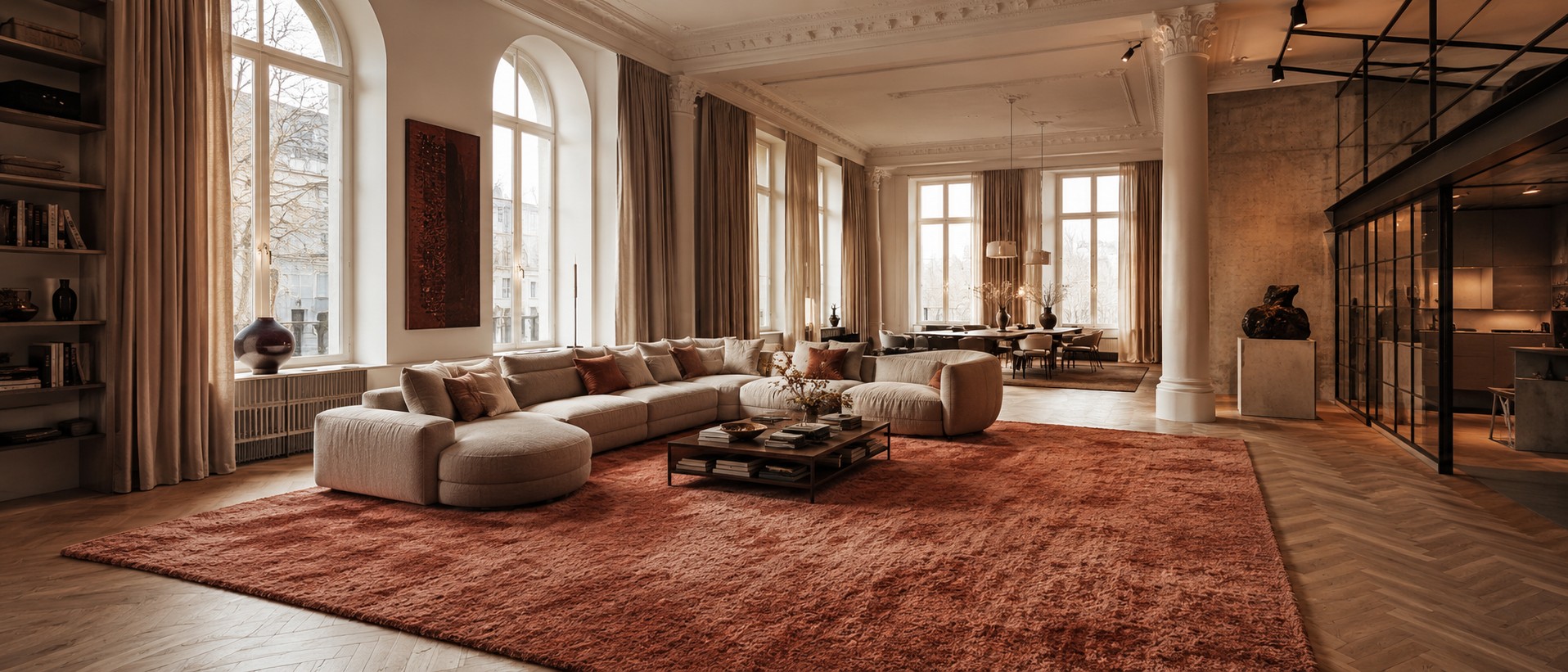
Imagine breakfast at the dining table, wooden parquet beneath you, four metres of ceiling height above, floor-to-ceiling windows behind. The coffee steams, but the first word echoes. That is what a beautiful period flat sounds like in the morning, before any textile has calmed the scene. Hard surfaces everywhere, barely anything to catch sound. The result: conversations feel tiring, music loses warmth, and the room feels somehow unfinished despite elegant furniture.
This is precisely where a high-quality rug comes in. It is not a technical aid, but a furnishing piece with a measurable acoustic effect. The solution lies quite literally on the floor.
How sound is generated and why the floor is so decisive
Sound waves follow physical rules: when they hit a hard, smooth surface, they are reflected back almost entirely. Concrete, parquet, tiles and glass are particularly effective reflective surfaces. The floor is the biggest problem because it offers the largest surface area in the room.
Textile surfaces interrupt this cycle. Fibres, loops and pile absorb sound energy and convert it into minimal heat. Acousticians measure this using the so-called NRC value (Noise Reduction Coefficient): a bare concrete floor achieves almost 0, while a thick wool rug with a suitable underlay reaches values between 0.25 and 0.55. This range sounds modest, but makes a noticeable difference in everyday life, particularly for speech and the mid-range frequencies we perceive most strongly when listening.
Honesty is important here: a rug does not replace professional acoustic measures for a home cinema or rehearsal room. For everyday living in a period flat, loft or living room, it is nevertheless the most effective and at the same time the most attractive solution.
Size matters: the surface area determines the effect
Many people buy a rug with their eyes first. A pretty 140 × 200 cm piece under the coffee table looks good. Acoustically, it changes little. The textile surface must be large enough to interrupt the relevant reflection paths on the floor.
In the living room this means: the entire seating group belongs on the rug, at least with the front legs of all furniture. In the dining area, the rug needs enough overhang around the table so that chairs remain fully on it even when pulled out. An overhang of 30 to 40 cm on each side is recommended. Formats such as 240 × 340 cm or 300 × 400 cm are not extravagant in a living room, but are proportionally as well as acoustically sensible.
Those living in a loft with an open-plan layout benefit from zoning: one large rug in the seating area, a separate one in the dining area, a runner in the hallway. Several rugs in different areas together achieve a noticeably stronger overall effect than a single piece.
Material and construction: what really absorbs sound
Not every rug is acoustically equal. Three factors are decisive: material, pile height and density.
- Wool is the strongest choice among natural fibres. Densely woven or hand-knotted wool rugs absorb sound well, regulate room humidity and provide a pleasant feel underfoot. An oriental rug made from high-quality, dense wool is an aesthetically and acoustically convincing choice, particularly in contrast to concrete, steel or polished parquet.
- High pile offers a particularly large absorbing fibre surface thanks to its volume. Cut-pile constructions tend to achieve more damping than loop-pile, because the free fibre ends provide more contact surface for sound waves. Density is the key factor: a loose, light high-pile rug performs less well than a compact, heavy one.
- Flatweave impresses with its easy-care handling and understated look. It lags behind pile rugs in terms of sound absorption. Well suited to rooms with moderate echo or as a complementary piece alongside other textiles, but too weak as a sole measure in strongly reverberant rooms.
- Hand-knotted rugs combine weight, density and material depth. Their high knot count makes them very good sound absorbers and long-lasting investments.
By "real rugs" we do not mean a certificate of origin. We mean the difference compared to thin carpet or printed lightweight pieces without textile substance. A real rug has weight, density and depth, and that is precisely what makes the acoustic difference.
Rug underlay: a small detail with an audible effect
A suitable rug underlay adds a further damping layer between the rug and the hard floor. In measurements, the NRC value rises by 0.10 to 0.20 points with a good underlay. This effect is particularly pronounced on concrete floors or tiles.
There are also practical benefits: the rug lies more firmly, feels softer and lasts longer. Anyone buying a large, high-quality rug should factor in the underlay as an integral part of the purchase.
The overall picture: the rug within a textile room concept
In strongly reverberant rooms with high ceilings and large glass surfaces, the rug alone rarely provides a complete solution. The effect multiplies when several textile elements work together.
- Curtains: Floor-length, heavy fabrics in front of large window fronts effectively dampen reflections from glass surfaces. Particularly in a loft with industrial glazing, this is one of the strongest additions.
- Upholstered furniture: Sofas and armchairs with fabric upholstery absorb sound. A voluminous upholstered sofa with a soft filling clearly outperforms a leather sofa for room acoustics.
- Shelves and wall surfaces: Filled bookshelves scatter sound through their irregular surface and interrupt direct reflections. A fully stocked shelf on a bare wall has a surprisingly audible effect.
- Cushions and throws: Every additional textile surface contributes to overall damping, even if the individual contribution remains small.
A well-furnished period-flat living room with a large wool rug, long linen fabrics at the windows and a fabric-upholstered sofa sounds noticeably quieter. This requires no technical concept, but a good feel for the space.
Placement: where the rug achieves the greatest effect
The rule of thumb is: the rug belongs where people spend time and where sounds are generated. In the living room, under the seating group. In the dining area, under the table, with sufficient overhang for chair movement. In the home office, under the desk, where it absorbs footfall and acoustically calms the immediate working environment. In the hallway, often the longest and most reverberant area of a period flat, a runner fulfils more than a decorative purpose.
A large rug placed freely in a room, far from furniture and seating areas, looks attractive but has a less targeted acoustic effect. The surface must be where sound is generated.
FAQ
How do I find the right rug for sound reduction?
Size first: the more floor area the rug covers, the stronger the acoustic effect. Material: wool, dense high-pile constructions and hand-knotted oriental rugs absorb the most. Pile and density: heavy, compact rugs perform better than light, loose models. Underlay: a suitable rug underlay measurably increases damping and improves the feel underfoot.
Are rugs in a loft really effective against echo?
On concrete floors, parquet and tiles the effect is clearly noticeable, because these floors reflect sound almost entirely. Lofts often need several rugs: a large surface in the living area, a separate rug in the dining area, a runner in the hallway. Consider walls and windows: heavy curtains and upholstered furniture considerably reinforce the overall effect. In very large, largely furnished lofts, a textile zoning concept is clearly superior to a single rug.
Does high pile absorb more sound than flatweave?
Yes, as a rule. More pile volume means more absorbing fibre surface. Cut-pile tends to achieve more damping than loop-pile. Flatweave is easier to care for and more understated in appearance, but absorbs significantly less. A dense wool rug at a medium pile height is often the best compromise: acoustically strong, long-lasting and versatile in style.
What rug size makes acoustic sense?
Living room: the entire seating group should stand on the rug, at least with the front legs of the furniture. Formats from 200 × 300 cm upwards are recommended. Dining area: the rug needs 30 to 40 cm of overhang per side beyond the table, so that chairs remain on it when pulled out. Small rugs under 160 × 230 cm have barely any acoustic effect in a living room and are better suited as a complementary piece. When in doubt: go larger.
What does a rug underlay do for acoustics?
A suitable underlay adds an additional damping layer between the rug and the hard floor. In measurements, the acoustic absorption value (NRC) rises with an underlay by approximately 0.10 to 0.20 points. The effect is particularly pronounced on concrete and tiles. Practical benefits: prevents slipping, makes the rug softer, protects the underside and extends its lifespan.