The Right Rug for Allergy Sufferers: Myth and Reality
The advice is everywhere, and it is largely wrong
Get a diagnosis for house dust allergy and someone will tell you to rip out the rugs. It sounds sensible. It is, however, an oversimplification that the evidence does not support. The Gemeinschaft umweltfreundlicher Teppichboden (GUI) and the German Allergy and Asthma Federation (DAAB) measured fine dust concentrations in more than 100 households. Rooms with carpet recorded 30.4 micrograms per cubic metre. Rooms with smooth flooring (parquet, laminate, tiles) came in at 62.9 µg/m³. For context: the EU limit for outdoor fine dust is 50 µg/m³. Hard floors in that study consistently exceeded it indoors.
The study is from 2005 and 2006, and no large-scale follow-up has been published since. It remains the most widely cited reference on this topic in the German-speaking world, and the figures are consistent across independent sources. They do not prove that every rug in every home will halve your fine dust exposure. They do show, clearly, that the floor covering alone does not tell the whole story.
Short-pile acts as a passive dust depot, smooth floors do not
Here is the physical reality: dust sitting on parquet is one draught, one opening door, one person walking past away from becoming airborne again. Rug fibres grip particles and hold them below breathing level. The rug is not filtering the air in any active sense. It is simply keeping what it catches out of circulation until the next time you vacuum.
That last part matters enormously. A rug that goes unvacuumed for weeks will eventually release what it has stored. The advantage over hard flooring is not built into the material alone. It depends on the combination of fibre type, pile height, and regular cleaning. Think of it like a reusable filter: useful when maintained, counterproductive when ignored.
Lanolin gives wool a natural edge against mites, with one important caveat
Wool fibres contain lanolin, a waxy fat secreted by sheep's sebaceous glands. It has two properties that matter here: it is antimicrobial, and it resists moisture. House dust mites need warm, humid conditions to survive and reproduce. Lanolin disrupts that microclimate within the fibre, making wool an unfriendly environment for them.
That mechanism is biologically plausible and described in several specialist sources. A peer-reviewed study isolating the lanolin effect specifically in woven rugs, as distinct from bedding or upholstery, has not been publicly identified. So the claim is reasonable, not proven beyond doubt. There is also a counterargument worth knowing: wool absorbs moisture. In a poorly ventilated room with high humidity, that absorption can work against the mite-inhibiting effect of lanolin. The conclusion is not that wool is ideal or unsuitable. It is that wool in short-pile form, in a dry, well-aired room, with consistent vacuuming, is a defensible choice for allergy sufferers. Anyone with a sensitivity to lanolin itself, which is uncommon but real, should look at synthetic options instead.
Pile height is the single most important decision you will make
Everything else (material, colour, weave pattern) is secondary to pile height. Short-pile rugs, broadly defined as those with a pile under around 10 mm, keep allergens close to the surface where a vacuum can reach them. Deep-pile rugs, shaggy styles, and flokati designs let particles sink far below what any standard vacuum head can extract. That is not a cleaning technique problem. It is a geometry problem, and no amount of careful hoovering solves it.
Once you have settled on short-pile, three materials are worth serious consideration:
- Wool (short-pile): The lanolin factor gives it a natural advantage against mites in dry conditions. Requires consistent care and suits rooms with good ventilation. Avoid if you are sensitive to lanolin.
- Synthetic fibres (polyamide or polypropylene): Low moisture absorption means mites find little to work with. Easy to clean and widely available. A practical, low-maintenance choice.
- Cotton: Many cotton rugs are machine-washable at 60 °C. Washing at that temperature kills mites. For smaller rugs in the bedroom or bathroom, this is a genuine advantage.
On room placement: a short-pile rug with a solid cleaning routine works well in the living room. The bedroom deserves more caution. If you do use a rug there, make it washable and keep it short. One thing worth knowing before the rug question even arises: the primary habitat of the house dust mite is the mattress, not the floor. Mite-proof mattress encasings deliver more allergy relief per action than any flooring decision. Sort the bed first.
Certifications tell you different things: know which is which
Several labels appear on rugs marketed to allergy sufferers. They are not interchangeable.
- TÜV Nord "Für Allergiker geeignet" (Suitable for Allergy Sufferers): The most specific TÜV certification for this purpose. It tests for volatile organic compounds (VOCs), various biocides and fungicides, and assesses allergenic potential through a basophil degranulation test conducted with participants from different allergy groups. Fine dust retention behaviour, assessed via the GUI test procedure, also feeds into the rating.
- ECARF Seal (European Centre for Allergy Research Foundation): Tests products against defined thresholds for allergens and harmful substances, with criteria reviewed against current scientific evidence on a regular basis.
- STANDARD 100 by OEKO-TEX: Every component of the rug (pile, backing, dyes, coatings) is tested for harmful substances. That is valuable, but it is a chemical safety certification, not an allergy suitability label. It says nothing about fine dust retention or allergenic potential in the clinical sense. Certificates can be verified individually on the OEKO-TEX website using the printed reference number.
- Blauer Engel (Blue Angel): Germany's environmental label prohibits a range of problematic chemicals in textile floor coverings. Relevant for anyone whose reactions are triggered by chemical substances rather than biological allergens.
A certificate is a starting point, not a guarantee. The most carefully tested rug, rarely cleaned with the wrong vacuum, offers less protection than a modest rug hoovered properly three times a week.
The cleaning routine matters more than the rug itself
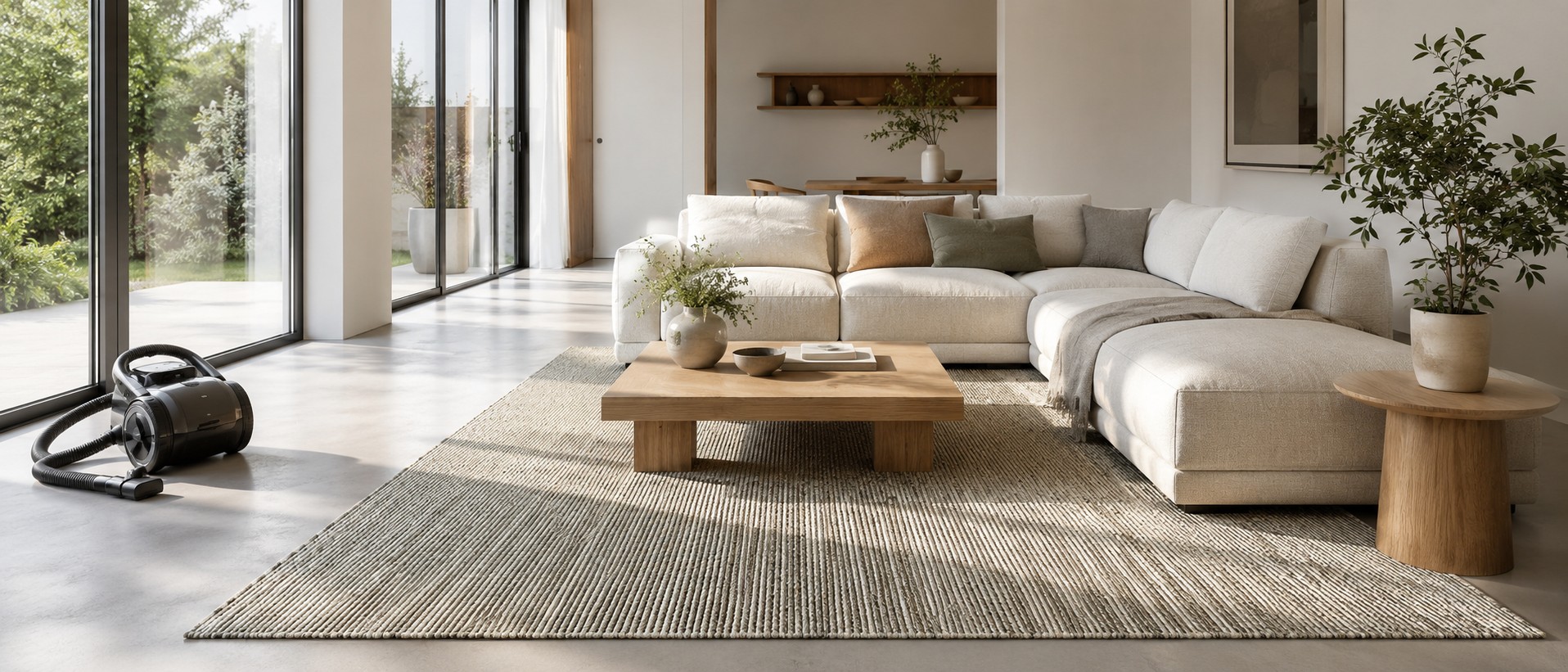
One piece of equipment is non-negotiable: a vacuum cleaner fitted with a HEPA filter, class H13 or H14. Older machines without HEPA filtration do lift particles from the rug and then expel a proportion of them back into the room through the exhaust. A class H14 filter retains virtually all particles. For allergy sufferers, this is not an upgrade. It is the baseline.
Recommended cleaning frequency:
- Ideal: daily in heavily used rooms
- Minimum: two to three times per week
- Deep clean: once or twice a year using a steam cleaner or specialist rug shampoo
Alongside vacuuming, keep indoor humidity below 50 per cent. That single measure removes the environmental conditions mites depend on. Regular ventilation helps achieve it. Anti-mite sprays come up repeatedly in home improvement guides. They can complement a cleaning routine but are no substitute for it, and several allergy organisations advise against relying on them as a primary measure.
FAQ
Is a rug bad for allergy sufferers?
As a blanket rule, no. A GUI and DAAB study measuring over 100 households found fine dust concentrations of 30.4 µg/m³ in rooms with carpet, compared to 62.9 µg/m³ on smooth floors. Short-pile fibres trap fine dust and keep it out of the air, rather than letting it circulate at floor level. The key condition is regular vacuuming with a HEPA-filtered machine.
Which rug is best for house dust allergy?
Short-pile with a pile height under approximately 10 mm. Deep-pile, shaggy, and flokati styles are unsuitable because allergens sink too far into the pile to be reliably removed. Washable cotton rugs or synthetic options in polyamide or polypropylene are easy to maintain. For reliable guidance on allergenic suitability, look for the TÜV Nord "Für Allergiker geeignet" certification or the ECARF seal.
Does wool help against mites?
In the right conditions, yes. Wool contains lanolin, a natural wax that is antimicrobial and moisture-resistant. House dust mites struggle to thrive where the humidity in the fibre is low. The mechanism is well-documented, though a peer-reviewed study isolating this effect specifically in woven rugs has not been publicly identified. Because wool also absorbs atmospheric moisture, the benefit depends on dry, well-ventilated rooms and consistent vacuuming. Anyone with a lanolin sensitivity should choose synthetic fibres instead.
Which certifications actually count for allergy-friendly rugs?
The most specific label is the TÜV Nord "Für Allergiker geeignet" certification: it tests allergenic potential, chemical emissions, and fine dust retention behaviour. The ECARF seal from the European Centre for Allergy Research Foundation is equally reliable. OEKO-TEX STANDARD 100 certifies that all components are free from harmful substances, which matters, but it is a chemical safety standard, not an allergy suitability label. It does not assess fine dust binding or allergenic properties.
How should I clean a rug if I have allergies?
Vacuum daily in heavily used rooms, at minimum two to three times per week. Always use a vacuum with a HEPA filter, class H13 or H14. Without it, fine particles are expelled back into the room through the exhaust. Deep-clean once or twice a year with a steam cleaner or rug shampoo. Keep indoor humidity below 50 per cent to deny house dust mites the conditions they need to reproduce.