Alum mordant: the age-old dyeing technique behind naturally dyed rugs
When a hand-knotted rug still displays deep, clear colours after years of use, an unassuming salt is often behind it: alum mordant. The substance is no modern invention; it has accompanied the dyeing craft since antiquity. And it explains a great deal about why some rugs age like a fine wine while others fade quickly. Let us take a closer look, from the medieval dyer's vat to care in the living room.
From the Egyptians to Pliny: alum as the oldest dyeing chemical
The Egyptians already knew alum. The earliest known finds date to 450 BC, when it was used as a flame retardant for wood. In the Middle Ages, alum became the universal chemical par excellence: a mordant in textile dyeing, an auxiliary in tanning, and also used in medicine.
The reason for this enormous importance is chemically simple. Before sulphuric acid could be produced industrially, alum was the most important source of sulphate ions. Anyone who wanted to dye could hardly do without it. How dependent the dyeing trade was on this raw material is illustrated by a curious power dynamic: for a long time, almost all countries dyeing with madder depended on two alum mines in Turkey. It was only in 1871, with the first synthetic alizarin, that this bottleneck was resolved.
One image from the dyer's workshop sticks in the mind: to ensure the colour survived the first wash, wool was first pre-treated with urine and alum. It sounds crude, but it worked. And at its core, the same principle applies to hand-knotted rugs to this day.
What mordanting actually does: the fibre becomes receptive first
Without a mordant, plant dye barely holds to the fibre. It washes out, fades, disappears. Mordants such as alum make the fabric fibre receptive to the dyes in the first place. That is the whole trick.
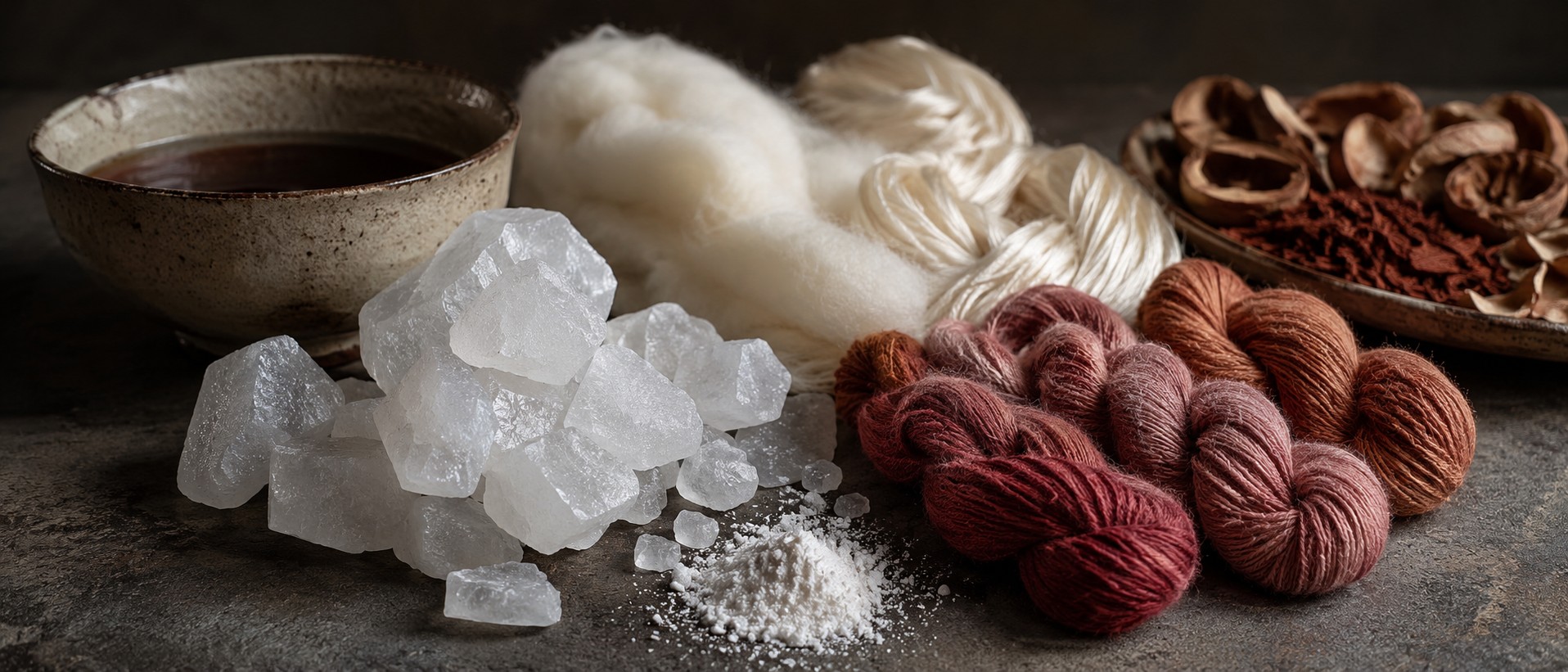
Chemically, alum is a double salt, potassium aluminium sulphate, formula KAl(SO₄)₂·12H₂O. It exists as a colourless, odourless crystalline mass or as a granular powder and dissolves in water, with the solution reacting slightly acidic. In dyeing, the aluminium components interact with the fibre and create firm anchor points to which the dye molecules can attach.
This works particularly well with animal fibres, that is, wool and silk. Alum is considered one of the most popular and versatile mordants precisely for these protein fibres. Plant-based fibres such as cotton or linen behave differently and additionally require treatment with tannins for the mordant to take effect. Anyone looking at a genuine wool rug with natural colours is therefore working in exactly the ideal field of application for alum.
Alum mordant in practice: dosage, temperature and mordant bath
The practice is remarkably hands-on. The dosage is based on the fibre weight, generally between 10 and 17 per cent alum relative to the weight of the wool. For 100 grams of wool, approximately 17 grams of alum usually suffice. The salt is added to water to create the mordant bath.
Temperature is where it gets interesting, because the fibre sets the pace. Wool can be treated hot, up to boiling point or around 85 to 95 °C. Silk, on the other hand, can tolerate a maximum of 70 °C, because at higher temperatures the fibre can break down. A subtle difference with major consequences.
Alongside the hot mordant method, there is the patient alternative: the skein of wool is left to soak in the mordant bath overnight so that the mordant can penetrate deeply. This is no shortcut; it is the opposite. This care is one of the reasons why naturally dyed rugs are more labour-intensive to produce than quickly synthetically dyed goods. Anyone wishing to buy such a rug is also paying for that time in the vat.
Alum colour nuances: the interplay of mordant and plant dye
Now for the most fascinating part: the colours. The mordant does not dye by itself, but it does influence which shade ultimately emerges. The same plant can yield entirely different results depending on the mordant used.
With alum on wool and silk in combination with madder, the result is a red with a blue to yellow tint. Aluminium salts such as alum generally shift the palette towards red. In one madder dyeing trial, alum produced a pronounced orange-red, for instance. Clear yellow tones are also frequently achieved on an alum mordant.
The contrast with other mordants makes the effect tangible:
| Mordant | Typical colour effect |
|---|---|
| Alum | Red tones with madder, clear yellow tones |
| Iron | Violet to brown, blackish tones |
| Copper | Yellow-olive, green-olive, brown |
| Tin | Strong yellow, orange |
Iron sulphate, for example, yielded a pronounced dark grey in the same madder trial. Over a tin mordant, the red nuance shifts again. This diversity is the essence of plant dyeing: a single dye pot, many possible results, controlled by the mordant.
Wash-fastness and light-fastness: the actual purpose of the mordant
Ultimately, it is about durability. Mordanted fibres absorb the dye more deeply, making colours clearer and more intense. Above all, they become stable. Wool dyed with madder and alum is characterised by high light-fastness and wash-fastness.
That is precisely the difference between a rug that retains its colour over generations and one that turns pale after a few washes. The mordant lays the foundation for value retention. For quality-conscious buyers, this is often the real purchasing argument behind naturally dyed wool rugs: colours that last.
Is alum truly non-toxic? Humans, children, pets and amphibians
In brief: for humans, alum is described as non-toxic in several sources and is considered one of the comparatively safe mordants. However, the picture is not entirely clear-cut. One source does classify the salt as toxic and advises against working with it around children. Some guides recommend, as a precaution, storing alum out of reach of young children and pets.
One point, however, is clearly documented: alum is lethal to amphibians. Residual mordant must therefore not enter the natural environment, neither into a stream nor into a garden pond. This concerns the production process, not your finished rug, but it shows that caution here makes sense.
One common misconception: alum in dyeing is not the same as the aluminium in deodorants. These are chemically different compounds, which must also be assessed separately in terms of health. For aluminium in antiperspirants, the German Federal Institute for Risk Assessment (BfR) has established a very low health risk. As a food additive, alum is designated E 522 and is strictly limited in the EU, approved only for egg white and glazed, candied or crystallised fruit and vegetables.
Sun protection and professional cleaning for naturally dyed rugs
An alum-mordanted rug is robust, but does deserve some attention. Hand-knotted Oriental rugs with plant dyes are particularly colour-sensitive. The most important everyday tip: avoid direct sunlight, as it can cause the colours to fade. A spot away from harsh midday light keeps the tones fresher for longer.
Restraint is advisable when it comes to cleaning. Most Oriental rugs consist of 100 per cent wool and are colour-fast, but beating them with a carpet beater is an erroneous practice that can cause serious damage. For deep cleaning, a visit to a specialist is recommended: as a rule of thumb, professional cleaning is suggested for hand-knotted rugs approximately every four years. This ensures that the work which began in the mordant bath remains visible for decades.
FAQ
Why has alum been used for dyeing since antiquity?
Because alum was the most important available source of sulphate ions for centuries, before sulphuric acid could be produced industrially. The Egyptians already knew the substance, and in the Middle Ages it was regarded as a universal chemical for dyeing, tanning and medicine. The earliest known finds date to 450 BC. As a mordant, it made the fibre receptive to dyes, which is why virtually no one could dye without it.
How does the mordanting process with alum work in practice?
Alum is dissolved in water and the fibre is mordanted in the resulting bath, with a dosage generally of 10 to 17 per cent relative to the fibre weight. For 100 grams of wool, approximately 17 grams of alum suffice. Wool is treated hot, at around 85 to 95 °C, whereas silk is treated at a maximum of 70 °C, as higher temperatures can cause it to break down. Alternatively, the skein of fibre is left to soak cold in the mordant bath overnight so that the mordant penetrates deeply.
How does alum affect the wash-fastness and light-fastness of rug colours?
Alum anchors the dye molecules firmly in the fibre, making the colours wash-fast and light-fast as a result. Wool dyed with madder and alum is characterised by high light-fastness and wash-fastness. In addition, the mordanted fibre absorbs the dye more deeply, so the tones become clearer and more intense. This is precisely what allows naturally dyed rugs to remain colour-stable over the years.
Is alum mordant for rugs truly non-toxic?
For humans, alum is described as non-toxic in several sources and is considered one of the comparatively safe mordants. However, the sources are inconsistent: one source classifies the salt as toxic, and some guides recommend keeping it away from young children and pets. It is clearly documented that residual mordant is lethal to amphibians and must therefore not enter waterways. This concerns the production process, not the finished rug.
Is alum as a food additive the same as the aluminium in deodorant?
No. Alum in dyeing is potassium aluminium sulphate and is chemically a different compound from the aluminium in antiperspirants. The two must also be assessed separately in terms of health. For aluminium in deodorants, the German Federal Institute for Risk Assessment has established a very low risk. As a food additive, alum carries the designation E 522 and is approved in the EU only for egg white and glazed, candied or crystallised fruit and vegetables.