Decorating with a Round Rug: the Style Guide for Every Room
The mistake that makes a round rug look lost
There is a classic error almost everyone makes at least once: the round rug ends up somewhere in the room, a little too small, a little too far from the furniture. And then it looks like a foreign object that happened to land on the floor.
Two things are usually behind it. First, the size: a rug that is too small visually divides the room and creates a restless feel. One that is too large dominates everything. Second, the placement. If the rug is not assigned to a clear purpose, it does not define a zone either. It floats.
The good news: both mistakes can be avoided with a few simple rules. That is exactly what this is about. When you want to decorate with a round rug, you need clear, logical criteria rather than guesswork. Let us start with the most important one.
Zoning: why the rug belongs at the centre of a purpose
Think about the room before you think about the rug. Where do you sit? Where do you eat? Where do you read? A rug belongs at the centre of that purpose, in the sofa corner, at the reading spot, or under the dining table. It creates a clear area and gives the furniture a frame. That is its actual job.
This shows particularly well in an open-plan layout with a kitchen, dining area, and living room. Here a round rug can break up the strict lines. Two rugs, one under the dining table and one by the seating group, create a relaxed overall picture without the areas competing with one another. This zoning makes a large open floor plan legible.
A reading corner works on the same principle. Imagine a room corner with an armchair, a small lamp, and a small round rug underneath. The rug alone turns it into a distinct area, a place that invites you to sit down. One single detail as a focal point, and the corner gains a purpose.
Making small rooms appear larger
The soft shape plays to its strengths in small rooms. Round rugs soften angles and make the room feel airier than hard edges do. They work well in corners, under small tables, or in reading nooks, and set a calm focal point in the process.
In a small living room of around 15 to 20 square metres, it is best to place the rug in front of the sofa and put only smaller pieces of furniture on it: a coffee table, perhaps a footstool, and a few accessories. Less on the surface means more openness here. A diameter of 100, 120, or 150 cm is perfectly sufficient depending on the furniture layout.
Colour also helps with the perception of space: light-coloured rugs appear understated and make the room look optically larger. A small round rug in front of an open shelving unit makes the area feel even more inviting.
The minimum size a round rug needs to be
Let us get to the numbers. For a round dining table, the rule of thumb is: table diameter plus approximately 120 to 140 cm. This leaves an overhang of around 60 to 75 cm on each side, slightly more or less depending on the source. The reasoning is practical: the chairs should remain comfortably on the rug even when pushed back.
An example makes it tangible. For a 4-seater round table with a diameter of 100 cm, a rug with a diameter of 200 cm is recommended. A table with a diameter of 120 cm requires at least 240 cm by calculation, and a table with a diameter of 140 cm needs approximately 260 cm. For the dining area, a low pile is sensible because chairs slide more easily on it and cleaning is simpler.
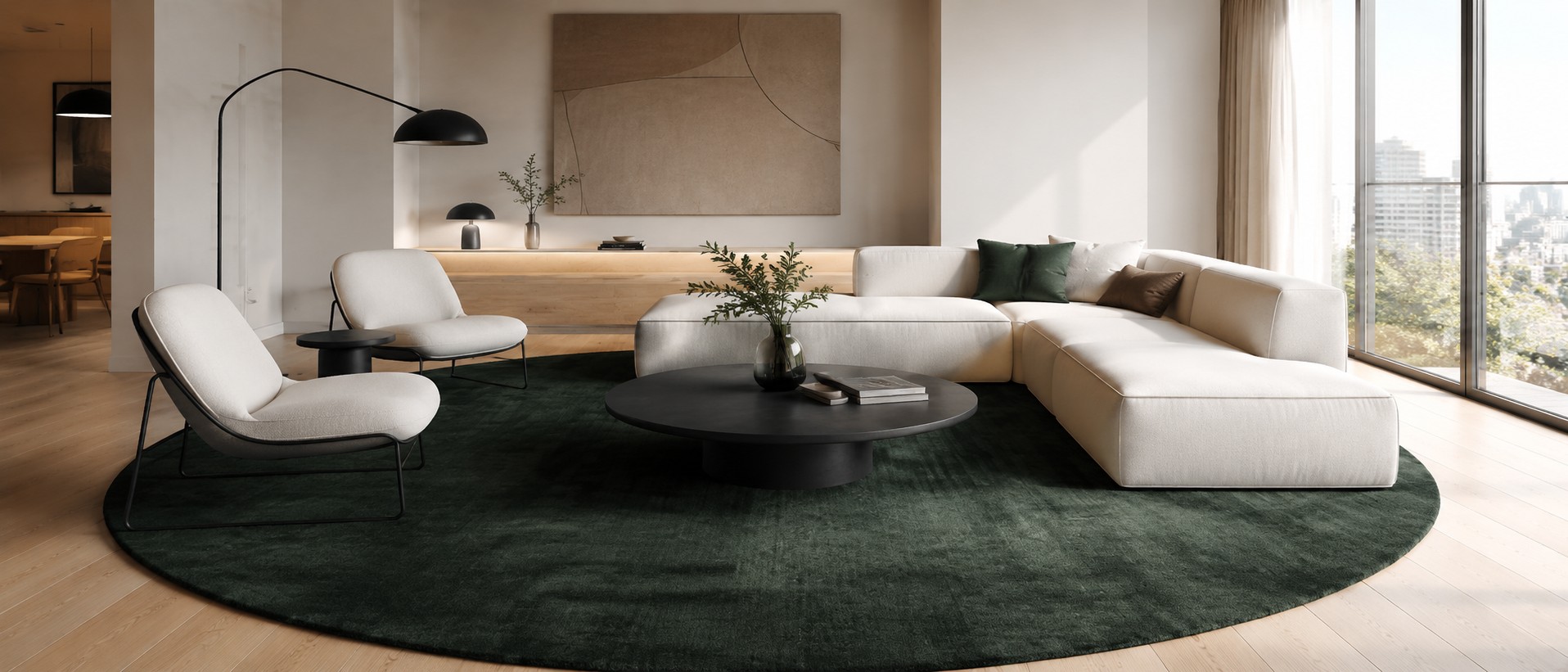
Table diameterRecommended rug diameter 100 cmapprox. 200 cm 120 cmapprox. 240 cm 140 cmapprox. 260 cmIn the seating area, the front-legs rule applies: at least the front legs of the sofa and armchairs should rest on the rug, so that a visual connection between the pieces of furniture is created. If the rug is only under the front feet, the room feels airier and this saves on depth. If you place the round rug only under the front sofa legs, it should be roughly as wide as the sofa itself.
Combining correctly with sofa, armchair, and coffee table
The front-legs rule is also the guiding principle when combining furniture. Pieces that belong to a living area should at least rest lightly on the rug. Even around 25 cm is enough for visual belonging. Furniture that stands entirely beside it looks isolated and creates restlessness.
Interior designers work with the four-two-zero rule for this: either four, two, or no legs stand on the rug. With three or just one leg, it looks as though the piece of furniture is about to tip off the rug. Stick to these three options and the look will sit right.
With placement, the room size is the deciding factor. In a small living room, you push the round rug centrally a little under the sofa so that it is anchored in the room. In a larger living room, it may lie freely in the centre and appear to float between the sofa and armchair. The coffee table on top of it then visually connects the elements. A larger rug should be placed as centrally as possible, because too far to one side makes the area look unbalanced. A distance of approximately 45 to 60 cm from the wall lets the floor breathe and frames the rug island.
When a round rug is the right choice
Two situations clearly favour the round shape. The first: many straight lines. A corner sofa, a rectangular coffee table, cabinets along the wall. A round rug loosens up this severity, feels more organic, and draws the eye to the centre. It breaks the hard edges and works well for smaller seating groups.
The second: existing round elements. Round tables, mirrors, or light fittings. A round rug reinforces this visual language. It looks most harmonious under a round dining table, and a round coffee table above a round rug forms a calm unit. A clean, straight-lined sofa with a round coffee table and a round rug is considered a modern, inviting combination in the Scandi style.
If either of these two criteria applies to your room, a round rug is the right choice. After that, simply pay attention to the size and the front-legs rule, and it will genuinely improve the room rather than looking lost.
FAQ
How do I place a round rug so it does not look lost?
Always assign it to a clear purpose and place it at the centre of that purpose, for example in the sofa corner, at the reading spot, or under the dining table. A rug that lands somewhere in the room defines no zone and looks like a foreign object. Size also matters: a rug that is too small visually divides the room. At least the front legs of the furniture should rest on the rug.
Does a round rug really make a small room look larger?
Yes, the soft shape feels airier than hard edges and makes small rooms appear larger. It is best to place the rug in front of the sofa and put only smaller pieces of furniture such as a coffee table and footstool on it. Light colours support the effect, as they appear understated and visually open up the room.
How do I define a reading or seating corner with a round rug?
Place a small round rug in the corner where your armchair and reading lamp are. This alone makes the area legible as a distinct space. The rug creates a clear surface and gives the furniture a frame, turning an ordinary corner into an inviting reading spot.
What is the minimum size for a round rug in front of a sofa?
If only the front legs of the sofa rest on it, the rug should be approximately as wide as the sofa itself. For a corner sofa, a margin of 15 to 30 cm relative to the sofa width is sufficient. The key is the front-legs rule: at least the front legs must be on the rug so that a visual connection is created.
Should the round rug be placed centrally or pushed under the sofa?
That depends on the room size. In a small living room, push it centrally a little under the sofa so that it is anchored in the room. In a larger living room, it may lie freely in the centre between the sofa and armchair and appear to float. A larger rug should always be placed as centrally as possible.